


LLC vs S Corp
for Small Business: Which Structure
Fits Your Tax Strategy?
Table of contents
- What Is an LLC?
- What Is an S Corporation?
- LLC vs S Corp: Which Is Better?
- LLC vs S Corp: Quick Comparison
- How LLC and S Corporation Taxes Work
- What Is Reasonable Compensation?
- When Should an LLC Consider an S Corp Election?
- Costs and Tax Factors To Consider
- LLC vs S Corp for a Growing Service Business
- How to Choose the Right Tax Treatment
- How to Make an S Corp Election for an LLC
- Conclusion
- Frequently Asked Questions
- Related BFG Tax Resources
- Deciding Whether Your LLC Should Elect S Corporation Status?
What Is an LLC?
What Is an S Corporation?
LLC vs S Corp: Which Is Better?
BFG Tax, a Business Financial Group company, connects business formation and tax strategy with owner compensation, payroll, accounting, cash flow, retirement planning, reporting, and growth.
LLC vs S Corp: Quick Comparison
| Factor | LLC with default tax treatment | LLC or corporation taxed as an S corporation |
|---|---|---|
Legal status |
An LLC formed under state law |
The underlying legal entity remains an LLC or corporation |
Federal tax status |
Usually a disregarded entity for one owner or a partnership for multiple owners |
S corporation tax treatment after an approved election |
Owners |
Called members |
Called shareholders for federal tax purposes |
Ownership eligibility |
Generally flexible, subject to state law |
Limited to eligible shareholders under federal tax rules |
Owner compensation |
Owners generally take draws or payments based on the LLC’s tax classification |
A working shareholder must receive reasonable compensation before receiving non-wage distributions |
Payroll for a working owner |
Generally unnecessary under default sole proprietor or partnership taxation |
Required when a shareholder performs services as an employee |
Federal business return |
A single-member LLC usually reports activity with the owner’s return; a multi-member LLC generally files Form 1065 |
The business files Form 1120-S and provides Schedule K-1 to each shareholder |
Allocation of profit and loss |
Multi-member LLCs taxed as partnerships may have greater allocation flexibility |
Tax items generally follow ownership percentages |
Ongoing administration |
Usually simpler |
Requires payroll, a separate business tax return, and additional records |
State treatment |
Varies by state |
Varies by state, and some states require a separate election or impose additional taxes and fees |
How LLC and S Corporation Taxes Work
A single-member LLC using default federal tax treatment generally reports net business profit on the owner’s personal return. The owner usually owes income tax and self-employment tax under the applicable rules. Owner draws do not determine the profit reported for tax purposes.
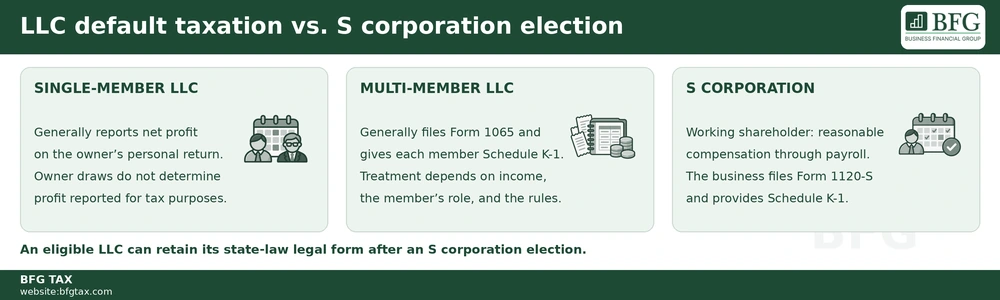
Potential savings come from employment-tax treatment. The calculation should include salary, remaining profit, payroll taxes and service, tax preparation, bookkeeping, state costs, and cash flow. The IRS sets no universal profit level for an S corporation election.
What Is Reasonable Compensation?
When Should an LLC Consider an S Corp Election?
- The business produces consistent, measurable profit.
- Profit is expected to remain after reasonable owner compensation.
- Cash flow can support regular payroll and payroll taxes.
- Accounting records are accurate and current.
- All owners meet S corporation eligibility rules.
- Estimated benefits exceed payroll, tax preparation, state, and administrative costs.
- The ownership structure and growth plans fit S corporation restrictions.
Default LLC taxation may remain suitable when profit is new or inconsistent, little remains after reasonable compensation, or added costs absorb the projected benefit. It may also support simpler administration or partnership flexibility.
Not Sure Whether an S Corp Election Makes Financial Sense?
Costs and Tax Factors To Consider
BFG Tax’s Payroll Solutions help coordinate owner compensation, payroll tax deposits, filings, and payroll records after the election takes effect.
Owners should also consider:
- Qualified business income deduction. Eligible owners of LLCs and S corporations may qualify, but wages earned as an employee are not qualified business income.
- Retirement contributions. An S corporation shareholder’s contributions are based on Form W-2 compensation, not distributions.
- Health insurance. Special reporting rules apply when an S corporation pays or reimburses premiums for a shareholder who owns more than 2%.
- Losses and owner basis. The ability to deduct losses can differ between S corporation shareholders and LLC members taxed as partners.
For planning owner payroll and other business payments, explore the Cash Flow Management Guide.
For managing supplier payments alongside other business cash needs, explore Bill Payments (Accounts Payable).
LLC vs S Corp for a Growing Service Business
Consider a single-member LLC that adds employees and earns more consistent profit. The owner’s work expands to people, client delivery, compliance, and operations.
Before electing S corporation status, the owner should review reasonable compensation, remaining profit, payroll, cash flow, accounting records, state requirements, and filing costs. BFG Tax’s CFO Advisory and Financial Strategy can help growing businesses evaluate how compensation and tax decisions may affect cash flow and future plans.
If your accounting workload exceeds your team’s capacity, explore BFG Talent Solutions.
How to Choose the Right Tax Treatment
1. How much profit does the business produce consistently?
2. What salary reflects the owner’s work and responsibilities?
3. How much profit is expected to remain after salary?
4. Can cash flow support payroll throughout the year?
5. What will payroll, bookkeeping, tax preparation, and state compliance cost?
6. Do all owners qualify as S corporation shareholders?
7. How could the election affect benefits, deductions, losses, and future ownership?
8. Are the accounting and payroll systems ready?
How to Make an S Corp Election for an LLC
Form 2553 generally must be filed no later than two months and 15 days after the start of the tax year when the election is intended to take effect. It may also be filed during the preceding tax year. Owners should review the current Form 2553 instructions.
If past filing problems have led to unresolved IRS notices, explore IRS Problem Resolution.
Conclusion
There is no universally better choice between default LLC taxation and an S corporation election. The appropriate treatment depends on consistent profit, reasonable owner compensation, payroll readiness, compliance costs, ownership, state requirements, and the company’s plans for growth.
Frequently Asked Questions
Does an S Corp election always reduce taxes?
No, the results depend on reasonable compensation, remaining profit, added costs, state treatment, and the owner’s tax situation.
Does an S Corp election change an LLC’s legal form?
The federal election generally does not change the LLC’s state-law legal form. Liability protection depends on state law and entity maintenance.
Does an LLC need to file Form 8832 before Form 2553?
An eligible LLC filing a timely Form 2553 generally does not need Form 8832 first; the election also provides corporate tax classification.
At what income level does an S Corp make sense?
Related BFG Tax Resources
Explore BFG Tax resources that connect entity choice with the systems required to support it:
Earlier-stage business?
Explore BFG Tax’s
Business Formation and Tax Strategy Guide.
Choose the Next Step for Your Business
Deciding Whether Your LLC Should Elect S Corporation Status?
For growing businesses with at least $500,000 in annual revenue and increasing complexity, BFG Tax’s 30- to 45-minute virtual Strategy Session reviews the current setup, identifies financial and tax-related gaps, and recommends an appropriate next step.
Have a question before booking? Contact BFG Tax or 844-BFG-4TAX.
Related BFG Tax Resources
Table of contents
- What Is an LLC?
- What Is an S Corporation?
- LLC vs S Corp: Which Is Better?
- LLC vs S Corp: Quick Comparison
- How LLC and S Corporation Taxes Work
- What Is Reasonable Compensation?
- When Should an LLC Consider an S Corp Election?
- Costs and Tax Factors To Consider
- LLC vs S Corp for a Growing Service Business
- How to Choose the Right Tax Treatment
- How to Make an S Corp Election for an LLC
- Conclusion
- Frequently Asked Questions
- Related BFG Tax Resources
- Deciding Whether Your LLC Should Elect S Corporation Status?
What Is an LLC?
What Is an S Corporation?
LLC vs S Corp: Which Is Better?
LLC vs S Corp: Quick Comparison
| Factor | LLC with default tax treatment | LLC or corporation taxed as an S corporation |
|---|---|---|
Legal status |
An LLC formed under state law |
The underlying legal entity remains an LLC or corporation |
Federal tax status |
Usually a disregarded entity for one owner or a partnership for multiple owners |
S corporation tax treatment after an approved election |
Owners |
Called members |
Called shareholders for federal tax purposes |
Ownership eligibility |
Generally flexible, subject to state law |
Limited to eligible shareholders under federal tax rules |
Owner compensation |
Owners generally take draws or payments based on the LLC’s tax classification |
A working shareholder must receive reasonable compensation before receiving non-wage distributions |
Payroll for a working owner |
Generally unnecessary under default sole proprietor or partnership taxation |
Required when a shareholder performs services as an employee |
Federal business return |
A single-member LLC usually reports activity with the owner’s return; a multi-member LLC generally files Form 1065 |
The business files Form 1120-S and provides Schedule K-1 to each shareholder |
Allocation of profit and loss |
Multi-member LLCs taxed as partnerships may have greater allocation flexibility |
Tax items generally follow ownership percentages |
Ongoing administration |
Usually simpler |
Requires payroll, a separate business tax return, and additional records |
State treatment |
Varies by state |
Varies by state, and some states require a separate election or impose additional taxes and fees |
How LLC and S Corporation Taxes Work
What Is Reasonable Compensation?
When Should an LLC Consider an S Corp Election?
- The business produces consistent, measurable profit.
- Profit is expected to remain after reasonable owner compensation.
- Cash flow can support regular payroll and payroll taxes.
- Accounting records are accurate and current.
- All owners meet S corporation eligibility rules.
- Estimated benefits exceed payroll, tax preparation, state, and administrative costs.
- The ownership structure and growth plans fit S corporation restrictions.
Not Sure Whether an S Corp Election Makes Financial Sense?
Costs and Tax Factors To Consider

BFG Tax’s Payroll Solutions help coordinate owner compensation, payroll tax deposits, filings, and payroll records after the election takes effect.
Owners should also consider:
- Qualified business income deduction. Eligible owners of LLCs and S corporations may qualify, but wages earned as an employee are not qualified business income.
- Retirement contributions. An S corporation shareholder’s contributions are based on Form W-2 compensation, not distributions.
- Health insurance. Special reporting rules apply when an S corporation pays or reimburses premiums for a shareholder who owns more than 2 percent.
- Losses and owner basis. The ability to deduct losses can differ between S corporation shareholders and LLC members taxed as partners.
LLC vs S Corp for a Growing Service Business
Before electing S corporation status, the owner should review reasonable compensation, remaining profit, payroll, cash flow, accounting records, state requirements, and filing costs. BFG Tax’s CFO Advisory and Financial Strategy can help growing businesses evaluate how compensation and tax decisions may affect cash flow and future plans.
How to Choose the Right Tax Treatment
1. How much profit does the business produce consistently?
2. What salary reflects the owner’s work and responsibilities?
3. How much profit is expected to remain after salary?
4. Can cash flow support payroll throughout the year?
5. What will payroll, bookkeeping, tax preparation, and state compliance cost?
6. Do all owners qualify as S corporation shareholders?
7. How could the election affect benefits, deductions, losses, and future ownership?
8. Are the accounting and payroll systems ready?
How to Make an S Corp Election for an LLC
Disclaimer:
This article provides general educational information. It does not provide legal or tax advice. Tax results depend on the facts of each business and the laws that apply to it.