


When an S Corp Election Makes Sense
for a Growing Business
An S Corp election may make sense when a business earns consistent profit beyond reasonable owner compensation, and the projected employment-tax benefit exceeds the added cost of payroll, tax preparation, bookkeeping, state filings, and administration.
BFG Tax, a Business Financial Group company, evaluates S corporation tax treatment as part of a connected financial system. The election affects owner compensation, payroll, accounting, cash flow, tax planning, reporting, and future growth.
Related: LLC Formation Services vs DIY Filing: What Business Owners Need to KnowThe result should show a reasonable net benefit after all recurring
Table of contents
- When Does an S Corp Election Make Sense?
- What Electing S Corporation Status Changes
- Five Signs the Election May Be Worth Evaluating
- Check Whether Your Business Is Ready
- Reasonable Compensation Is Central to the Decision
- When the Election May Not Be a Good Fit
- Example: A Growing Service Business
- How to Elect S Corp Status
- Questions to Answer Before Filing Form 2553
- Conclusion
- Frequently Asked Questions
- Related BFG Tax Resources
- Choose the Next Step for Your Business
When Does an S Corp Election Make Sense?
What Electing S Corporation Status Changes
Five Signs the Election May Be Worth Evaluating
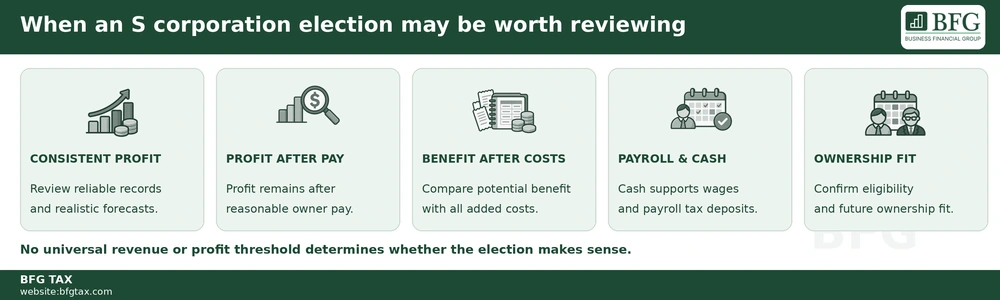
1. Profit Is Consistent
2. Profit Remains After Reasonable Compensation
3. Projected Savings Exceed the Added Costs
- Reasonable owner compensation
- Profit expected to remain after wages and expenses
- Employer and employee payroll taxes
- Payroll processing and payroll-return costs
- Form 1120-S preparation
- Additional bookkeeping and administrative work
- State elections, taxes, minimum fees, and filing costs
- Effects on deductions, benefits, and retirement contributions
The result should show a reasonable net benefit after all recurring costs. BFG Tax’s proactive tax planning connects this calculation with the owner’s wider tax position and business plans.
4. Payroll and Cash Flow Are Ready
For planning cash needs around owner payroll and business obligations, explore the Cash Flow Management Guide.
If your accounting workload exceeds your team’s capacity, explore BFG Talent Solutions.
For managing supplier payments alongside other business cash needs, explore Bill Payments (Accounts Payable).
5. The Ownership Structure Supports S Corporation Rules
Future ownership and expansion plans should be reviewed before the election. BFG Tax’s Business Formation Solutions evaluate tax treatment alongside ownership, operations, and long-term growth.
Check Whether Your Business Is Ready
Reasonable Compensation Is Central to the Decision
When the Election May Not Be a Good Fit
Example: A Growing Service Business
How to Elect S Corp Status
- Confirm the effective date and retain the IRS acceptance notice
- Establish shareholder-employee payroll
- Coordinate federal and state payroll registrations and filings
- Update accounting procedures for wages and distributions
- Maintain documentation supporting reasonable compensation
- Plan for Form 1120-S, Schedule K-1, and state returns
- Review shareholder health insurance and retirement-plan treatment
If past filing problems have led to unresolved IRS notices, explore IRS Problem Resolution.
Questions to Answer Before Filing Form 2553
- Does the business qualify for S corporation status?
- Is profit consistent enough to support regular payroll?
- What amount represents reasonable owner compensation?
- How much profit is expected to remain after salary and expenses?
- What are the total federal, state, payroll, accounting, and filing costs?
- How will the election affect cash flow, benefits, and retirement contributions?
- Are the accounting and payroll systems ready for the effective date?
- Does the election support future ownership and growth plans?
Conclusion
Frequently Asked Questions
Is there a minimum income required for an S Corp election?
Can an LLC elect S Corp status?
Does S Corporation Status Eliminate Income Tax?
Can a business file Form 2553 late?
Related BFG Tax Resources
Earlier-stage business?
Use the BFG Tax LLC vs S Corp Decision Checklist or explore the Business Formation and Tax Strategy Guide.
Choose the Next Step for Your Business
Choose the Next Step for Your Business
For growing businesses with at least $500,000 in annual revenue and increasing financial complexity, BFG Tax can evaluate whether S corporation tax treatment fits the company’s compensation, payroll, accounting, cash flow, and tax strategy.
Have a question before booking?
Contact BFG Tax or call 844-BFG-4TAX.
Table of contents
- When Does an S Corp Election Make Sense?
- What Electing S Corporation Status Changes
- Five Signs the Election May Be Worth Evaluating
- Check Whether Your Business Is Ready
- Reasonable Compensation Is Central to the Decision
- When the Election May Not Be a Good Fit
- Example: A Growing Service Business
- How to Elect S Corp Status
- Questions to Answer Before Filing Form 2553
- Conclusion
- Frequently Asked Questions
- Related BFG Tax Resources
- Choose the Next Step for Your Business
When Does an S Corp Election Make Sense?
The election deserves review when the business has stable profit, can pay the working owner a reasonable salary, and expects profit to remain after that salary and other expenses. That remaining profit may be distributed to shareholders and is generally not subject to employment taxes, although it remains subject to income tax under the applicable rules.
The potential benefit must be compared with the costs and responsibilities created by the election. A business should complete this analysis before filing Form 2553 or changing how the owner is paid.
What Electing S Corporation Status Changes
An LLC that elects S corporation taxation generally remains an LLC under state law. The election changes its federal tax treatment.
A working shareholder becomes an employee for compensation purposes. The company must run payroll, withhold and deposit applicable payroll taxes, issue Form W-2, and file employment tax returns. The business also files Form 1120-S and provides Schedule K-1 to its shareholders.
The IRS S corporation requirements also limit eligible shareholders, the number of shareholders, and classes of stock. State treatment must be reviewed separately because some states require additional elections, returns, taxes, or fees.
Five Signs the Election May Be Worth Evaluating
1. Profit Is Consistent
One strong year does not establish that the economics will continue. Review recent financial statements, current-year results, expected expenses, hiring plans, and realistic forecasts.
Consistent profit matters because payroll and tax-return obligations continue even when revenue slows. Current accounting and bookkeeping provide the information needed to evaluate the decision using reliable numbers.
2. Profit Remains After Reasonable Compensation
The potential employment-tax benefit generally comes from profit remaining after reasonable shareholder-employee wages. When most or all business profit would be needed for a reasonable salary, there may be little remaining distribution to support meaningful savings.
This point is especially important for consultants, contractors, agencies, and professional service firms whose revenue may depend heavily on the owner’s personal work.
3. Projected Savings Exceed the Added Costs
The analysis should compare the estimated tax treatment under the current classification with the projected result under S corporation taxation.
A practical calculation should include:
- Reasonable owner compensation
- Profit expected to remain after wages and expenses
- Employer and employee payroll taxes
- Payroll processing and payroll-return costs
- Form 1120-S preparation
- Additional bookkeeping and administrative work
- State elections, taxes, minimum fees, and filing costs
- Effects on deductions, benefits, and retirement contributions
The result should show a reasonable net benefit after all recurring costs. BFG Tax’s proactive tax planning connects this calculation with the owner’s wider tax position and business plans.
4. Payroll and Cash Flow Are Ready
A shareholder-employee must be paid through payroll on a reliable schedule. The business needs enough cash to cover wages, payroll tax deposits, operating expenses, estimated taxes, and distributions without creating shortages.
Payroll Solutions can help coordinate owner compensation, tax deposits, filings, and accounting records once the election takes effect.
5. The Ownership Structure Supports S Corporation Rules
The business must meet federal eligibility requirements and obtain the required shareholder consents. Plans involving foreign owners, entity owners, multiple economic classes, or certain investment structures may conflict with S corporation restrictions.
Future ownership and expansion plans should be reviewed before the election. BFG Tax’s Business Formation Solutions evaluate tax treatment alongside ownership, operations, and long-term growth.
Check Whether Your Business Is Ready
Use the BFG Tax LLC vs S Corp Decision Checklist to review profit, reasonable compensation, payroll readiness, state requirements, and recurring costs before discussing an election with your advisor.
Reasonable Compensation Is Central to the Decision
The IRS requires an S corporation to pay reasonable compensation to a shareholder-employee for services before making non-wage distributions to that shareholder-employee. The IRS may reclassify distributions as wages when compensation is unreasonably low.
Relevant factors include the owner’s training, duties, experience, time devoted to the business, comparable compensation, payments to other employees, and the source of the company’s revenue. The IRS reasonable compensation guidance does not establish one salary percentage for every business.
Compensation should be documented and reviewed as responsibilities and financial results change.
When the Election May Not Be a Good Fit
Electing S corporation status may provide limited value when profits are inconsistent, little profit remains after reasonable compensation, or annual compliance costs absorb the projected benefit.
It may also be unsuitable when the business cannot maintain payroll, the accounting records are not current, an owner is ineligible, or future financing requires an ownership structure that S corporation rules do not allow. State taxes and fees can also change the result.
Waiting can be appropriate when the financial and operational requirements are not ready. The business can review the election again as profitability, staffing, ownership, and cash flow change.
Some structures offer broad ownership flexibility. Others limit eligible owners or how economic rights can be arranged. A structure may also influence how lenders or investors review the company, how profits are allocated, and what must happen when ownership changes.
Example: A Growing Service Business
Consider a single-owner consulting business with recurring clients, employees, and increasingly consistent profit. The owner still manages client work but now spends more time supervising employees, managing operations, and developing the company.
The review would begin with current financial statements and a reasonable compensation analysis. It would then estimate remaining profit, payroll taxes, compliance costs, state obligations, and cash needed for operations. Hiring and expansion plans would also be considered.
This is a hypothetical example. It does not describe a BFG Tax client or promise tax savings. The appropriate decision depends on the company’s records, the owner’s responsibilities, and applicable federal and state rules.
How to Elect S Corp Status
An eligible business generally makes the federal election by filing Form 2553 with the consent of its shareholders.
The form generally must be filed no later than two months and 15 days after the beginning of the tax year when the election is intended to take effect. It may also be filed during the preceding tax year. Review the current Form 2553 instructions for eligibility, signatures, deadlines, and filing locations.
Some businesses may qualify for late-election relief. Eligibility and filing requirements should be reviewed promptly because relief is not automatic in every situation.
Filing the form is only one part of implementation. The business should also:
- Confirm the effective date and retain the IRS acceptance notice
- Establish shareholder-employee payroll
- Coordinate federal and state payroll registrations and filings
- Update accounting procedures for wages and distributions
- Maintain documentation supporting reasonable compensation
- Plan for Form 1120-S, Schedule K-1, and state returns
- Review shareholder health insurance and retirement-plan treatment
Questions to Answer Before Filing Form 2553
- Does the business qualify for S corporation status?
- Is profit consistent enough to support regular payroll?
- What amount represents reasonable owner compensation?
- How much profit is expected to remain after salary and expenses?
- What are the total federal, state, payroll, accounting, and filing costs?
- How will the election affect cash flow, benefits, and retirement contributions?
- Are the accounting and payroll systems ready for the effective date?
- Does the election support future ownership and growth plans?
CFO Advisory and Financial Strategy can help growing businesses evaluate the election alongside cash flow, hiring, expansion, and longer-term financial decisions.
Conclusion
S corporation tax treatment may make sense when a business has consistent profit remaining after reasonable owner compensation and the potential employment-tax benefit exceeds the added payroll, accounting, tax preparation, state, and administrative costs. Eligibility, cash flow, ownership, and operational readiness also matter. Reviewing these factors together helps determine whether the election supports the business’s current financial position and plans for growth.
Frequently Asked Questions
Is there a minimum income required for an S Corp election?
Can an LLC elect S Corp status?
Does S Corporation Status Eliminate Income Tax?
Can a business file Form 2553 late?
Related BFG Tax Resources
Earlier-stage business?
Use the BFG Tax LLC vs S Corp Decision Checklist or explore the Business Formation and Tax Strategy Guide.
Choose the Next Step for Your Business
Choose the Next Step for Your Business
For growing businesses with at least $500,000 in annual revenue and increasing financial complexity, BFG Tax can evaluate whether S corporation tax treatment fits the company’s compensation, payroll, accounting, cash flow, and tax strategy.
Have a question before booking?
Contact BFG Tax or call 844-BFG-4TAX.
Related BFG Tax Resources
This article provides general educational information and does not constitute legal or tax advice. Tax results depend on each business’s circumstances and applicable laws.