


What to Review as Your LLC Business Grows

What Changes When Your LLC Starts Growing?
| If your business changes | Focus on | Why it matters |
|---|---|---|
Higher revenue or profit |
Higher profit can make tax planning more important. It does not automatically make the current tax treatment unsuitable. | |
New employees |
Payroll systems |
Employees create payroll, withholding, and employment tax responsibilities. |
New owners |
Ownership structure |
A new owner affects ownership rights, distributions, and tax treatment, and legal agreements need review. |
New states |
State requirements |
Registration and tax obligations are separate questions that depend on your activities and each state’s rules. |
More complex finances |
Financial reporting |
Growing activity needs records that show cash flow, payroll costs, and profitability. |
Changing owner compensation |
Compensation planning |
Owner pay depends on how the LLC is taxed, and draws, distributions, and wages are treated differently. |
New line of business |
Entity structure |
A separate activity may carry different risks and tax considerations, so it is worth checking whether it fits in the current LLC. |
As your LLC grows, understanding how your business structure affects taxes, payroll, and long-term growth can help you identify which areas of your current setup need review.
What Should You Review for Each Change?
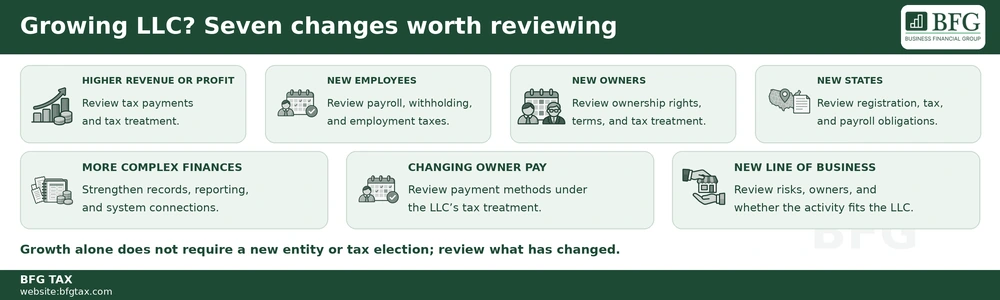
1. Higher Revenue or Profit: Review Your LLC Tax Planning
What changes: Your business earns more income or retains more profit after expenses than it did when the LLC was formed.
Why it matters: Higher profits can change which tax approach may be most appropriate. However, higher profits do not automatically mean that your current tax treatment is no longer suitable.
Check: Is the higher profit sustainable? Review your projected annual tax liability, whether estimated tax payments or withholding need adjustment, and how much cash to reserve for taxes. Confirm the LLC’s current tax classification and how owner compensation works under it. If considering a change, compare the potential benefit with added payroll, administrative, and filing costs. Tax planning still matters even when your existing tax classification stays the same.
2. New Employees: Review Payroll and Employment Requirements
What changes: The business begins managing employee compensation and payroll.
Why it matters: Hiring employees introduces payroll, withholding, employment tax, and reporting responsibilities that must be handled accurately and consistently.
Check: Whether payroll, tax withholding, and employment tax reporting are properly set up and handled consistently.
3. New Owners: Review Ownership and Entity Structure
What changes: Another person acquires an ownership interest in the business.
Why it matters: Adding a new owner can change how ownership interests, responsibilities, profits, distributions, and tax treatment are structured. The impact depends on the LLC’s existing tax classification and the terms of the ownership change.
Check: Review the operating agreement, the new owner’s rights and responsibilities, how profits and distributions will be shared, and whether the current tax treatment still fits. Have an attorney review the operating agreement and any other legal agreements related to the ownership change.
4. Expansion Into New States: Review State Requirements
What changes: The business begins operating, hiring, or conducting business activities in another state.
Why it matters: Expanding into another state can create registration, tax, payroll, and reporting requirements that did not apply when the business operated in only one state. Registration and tax obligations are separate questions, and each depends on the business’s activities and the rules of the state involved.
Check: Whether the business must register in the new state and which taxes may apply. Where relevant, also check payroll registration, withholding, and reporting requirements for employees working in that state.
5. More Complex Finances: Strengthen Accounting and Financial Reporting
What changes: The business has more customers, transactions, expenses, employees, or financial activity to track.
Why it matters: Basic records may no longer provide the information needed for accurate tax reporting or informed business decisions. As the business becomes more complex, you may need clearer information on monthly cash flow, payroll costs, profitability by product or service, unpaid invoices and bills, and owner payments.
Check: Are bank and credit card accounts reconciled regularly? Are monthly financial reports timely and reliable? Can you track unpaid invoices, bills, payroll costs, and profitability by product or service? Check whether accounting, payroll, and invoicing systems share accurate information, and assign responsibility for reviewing discrepancies. Reliable records also support cash flow forecasts and decisions about hiring or expansion.
6. Changing Owner Compensation: Review Compensation Planning
What changes: As the business becomes more profitable, the owner may want to change how they receive money from the business.
Why it matters: How an owner can be paid depends on how the LLC is taxed. Draws, distributions, and wages are treated differently for tax purposes, so an owner cannot simply choose the payment method they prefer.
Check: How the LLC is taxed, how each type of owner payment is treated under that tax treatment, and how your approach affects payroll, taxes, and cash flow.
7. New Line of Business: Review Entity Structure
What changes: The business starts a separate activity, such as a new service, product, or property, that differs from what the LLC was formed to do.
Why it matters: A separate activity can carry different risks, contracts, and tax considerations than the original business. Whether it belongs in the same LLC or in an additional entity depends on the activity, the owners, and the rules of the state involved.
Check: Whether the new activity brings different liability or insurance needs, whether it involves different owners or lenders, and how an additional entity would be taxed and administered. Have an attorney and a tax professional confirm the plan.
What Are Your Options for Managing a Growing Business?
When Should You Get Professional Help?
Consider professional help when a change creates tax, legal, payroll, or accounting questions you cannot confidently resolve. One significant issue can be enough; the need for support depends on its nature and potential consequences, not the number of changes.
When Your Business Has Changed Since Formation
A Quick Check: Is It Time?
- Has anything changed since you formed the LLC, such as owners, employees, states, or how you pay yourself?
- Have you kept the same tax approach since formation, without a review?
- Would a wrong tax or structure decision cost more today than it would have at formation?
Use these questions to identify areas to review, not to score your business. A single change, such as adding an owner or hiring in another state, may need specialist advice. If none applies, continue reviewing your records and obligations as part of routine business planning.
Conclusion
Frequently Asked Questions
Does revenue growth mean I have to change my LLC's structure or tax treatment?
Not automatically. Revenue growth alone does not require a new entity or a new tax election. It does mean you should review whether the structure, tax strategy, payroll, and accounting still fit the business you run today. A new owner, new employees, a new state, or higher income can each call for that review.
When does growth call for a new entity or a restructuring?
Growth alone does not require either. Different ownership arrangements, liability concerns, financing requirements, or a separate business activity may justify reviewing the legal structure. A change in federal tax classification does not necessarily require forming a new LLC. Have an attorney and a tax professional evaluate the legal, tax, and administrative effects before deciding.
What tax payments should a growing LLC review?
Review projected income, estimated tax payments or withholding, and cash reserved for taxes as profit changes. Who pays income tax depends on the LLC’s tax classification. Also review payroll taxes and applicable state or local taxes when employees, locations, or activities change. Confirm payment amounts and deadlines with your tax professional.
When should a growing business review its LLC structure?
Review it when ownership, employees, states, income, or owner pay change. A single significant change can justify professional advice. The review may identify updates to tax planning, accounting, payroll, or registrations without requiring a different legal entity.
What accounting changes should a growing LLC consider?
Review bank reconciliations, monthly financial reports, invoice collection, bill tracking, and records of owner payments. As transactions and staff increase, check whether accounting, payroll, and invoicing systems work together reliably. The goal is accurate records and useful information for tax planning, cash flow, and business decisions.
Related BFG Tax Resources
Earlier-stage business?
Explore BFG Tax’s Business Formation and Tax Strategy Guide to understand the decisions beyond the filing.
Choose the Next Step for Your Business
Discuss Your Business Structure and Tax Planning
Is growth making your tax planning, accounting, or payroll harder to manage? Our team can discuss what has changed, how your current processes work together, and where you may need support.
In a 30- to 45-minute virtual Strategy Session, we discuss your business structure, goals, and current financial, operational, and tax challenges. You gain clarity on the support your business needs and a recommendation for the next step.
Have a question before booking?
Contact BFG Tax or call 844-BFG-4TAX.
What Changes When Your LLC Starts Growing?
| If your business changes | Focus on | Why it matters |
|---|---|---|
Higher revenue or profit |
LLC tax strategy |
Higher profit can make tax planning more important. It does not automatically make the current tax treatment unsuitable. |
New employees |
Payroll systems |
Employees create payroll, withholding, and employment tax responsibilities. |
New owners |
Ownership structure |
A new owner affects ownership rights, distributions, and tax treatment, and legal agreements need review. |
New states |
State requirements |
Registration and tax obligations are separate questions that depend on your activities and each state’s rules. |
More complex finances |
Financial reporting |
Growing activity needs records that show cash flow, payroll costs, and profitability. |
Changing owner compensation |
Compensation planning |
Owner pay depends on how the LLC is taxed, and draws, distributions, and wages are treated differently. |
New line of business |
Entity structure |
A separate activity may carry different risks and tax considerations, so it is worth checking whether it fits in the current LLC. |
What Should You Review for Each Change?
1. Higher Revenue or Profit: Review Your LLC Tax Planning
What changes: Your business earns more income or retains more profit after expenses than it did when the LLC was formed.
Why it matters: Higher profits can change which tax approach may be most appropriate. However, higher profits do not automatically mean that your current tax treatment is no longer suitable.
Check: Is the higher profit sustainable? Review your projected annual tax liability, whether estimated tax payments or withholding need adjustment, and how much cash to reserve for taxes. Confirm the LLC’s current tax classification and how owner compensation works under it. If considering a change, compare the potential benefit with added payroll, administrative, and filing costs. Tax planning still matters even when your existing tax classification stays the same.
2. New Employees: Review Payroll and Employment Requirements
What changes: The business begins managing employee compensation and payroll.
Why it matters: Hiring employees introduces payroll, withholding, employment tax, and reporting responsibilities that must be handled accurately and consistently.
Check: Whether payroll, tax withholding, and employment tax reporting are properly set up and handled consistently.
3. New Owners: Review Ownership and Entity Structure
What changes: Another person acquires an ownership interest in the business.
Why it matters: Adding a new owner can change how ownership interests, responsibilities, profits, distributions, and tax treatment are structured. The impact depends on the LLC’s existing tax classification and the terms of the ownership change.
Check: Review the operating agreement, the new owner’s rights and responsibilities, how profits and distributions will be shared, and whether the current tax treatment still fits. Have an attorney review the operating agreement and any other legal agreements related to the ownership change.
4. Expansion Into New States: Review State Requirements
What changes: The business begins operating, hiring, or conducting business activities in another state.
Why it matters: Expanding into another state can create registration, tax, payroll, and reporting requirements that did not apply when the business operated in only one state. Registration and tax obligations are separate questions, and each depends on the business’s activities and the rules of the state involved.
Check: Whether the business must register in the new state and which taxes may apply. Where relevant, also check payroll registration, withholding, and reporting requirements for employees working in that state.
5. More Complex Finances: Strengthen Accounting and Financial Reporting
What changes: The business has more customers, transactions, expenses, employees, or financial activity to track.
Why it matters: Basic records may no longer provide the information needed for accurate tax reporting or informed business decisions. As the business becomes more complex, you may need clearer information on monthly cash flow, payroll costs, profitability by product or service, unpaid invoices and bills, and owner payments.
Check: Are bank and credit card accounts reconciled regularly? Are monthly financial reports timely and reliable? Can you track unpaid invoices, bills, payroll costs, and profitability by product or service? Check whether accounting, payroll, and invoicing systems share accurate information, and assign responsibility for reviewing discrepancies. Reliable records also support cash flow forecasts and decisions about hiring or expansion.
6. Changing Owner Compensation: Review Compensation Planning
What changes: As the business becomes more profitable, the owner may want to change how they receive money from the business.
Why it matters: How an owner can be paid depends on how the LLC is taxed. Draws, distributions, and wages are treated differently for tax purposes, so an owner cannot simply choose the payment method they prefer.
Check: How the LLC is taxed, how each type of owner payment is treated under that tax treatment, and how your approach affects payroll, taxes, and cash flow.
7. New Line of Business: Review Entity Structure
What changes: The business starts a separate activity, such as a new service, product, or property, that differs from what the LLC was formed to do.
Why it matters: A separate activity can carry different risks, contracts, and tax considerations than the original business. Whether it belongs in the same LLC or in an additional entity depends on the activity, the owners, and the rules of the state involved.
Check: Whether the new activity brings different liability or insurance needs, whether it involves different owners or lenders, and how an additional entity would be taxed and administered. Have an attorney and a tax professional confirm the plan.
What Are Your Options for Managing a Growing Business?
When Should You Get Professional Help?
Consider professional help when a change creates tax, legal, payroll, or accounting questions you cannot confidently resolve. One significant issue can be enough; the need for support depends on its nature and potential consequences, not the number of changes.
When Your Business Has Changed Since Formation
A Quick Check: Is It Time?
- Has anything changed since you formed the LLC, such as owners, employees, states, or how you pay yourself?
- Have you kept the same tax approach since formation, without a review?
- Would a wrong tax or structure decision cost more today than it would have at formation?
Use these questions to identify areas to review, not to score your business. A single change, such as adding an owner or hiring in another state, may need specialist advice. If none applies, continue reviewing your records and obligations as part of routine business planning.
Conclusion
Frequently Asked Questions
Does revenue growth mean I have to change my LLC's structure or tax treatment?
Not automatically. Revenue growth alone does not require a new entity or a new tax election. It does mean you should review whether the structure, tax strategy, payroll, and accounting still fit the business you run today. A new owner, new employees, a new state, or higher income can each call for that review.
When does growth call for a new entity or a restructuring?
Growth alone does not require either. Different ownership arrangements, liability concerns, financing requirements, or a separate business activity may justify reviewing the legal structure. A change in federal tax classification does not necessarily require forming a new LLC. Have an attorney and a tax professional evaluate the legal, tax, and administrative effects before deciding.
What tax payments should a growing LLC review?
Review projected income, estimated tax payments or withholding, and cash reserved for taxes as profit changes. Who pays income tax depends on the LLC’s tax classification. Also review payroll taxes and applicable state or local taxes when employees, locations, or activities change. Confirm payment amounts and deadlines with your tax professional.
When should a growing business review its LLC structure?
Review it when ownership, employees, states, income, or owner pay change. A single significant change can justify professional advice. The review may identify updates to tax planning, accounting, payroll, or registrations without requiring a different legal entity.
What accounting changes should a growing LLC consider?
Review bank reconciliations, monthly financial reports, invoice collection, bill tracking, and records of owner payments. As transactions and staff increase, check whether accounting, payroll, and invoicing systems work together reliably. The goal is accurate records and useful information for tax planning, cash flow, and business decisions.
Related BFG Tax Resources
Earlier-stage business?
Explore BFG Tax’s Business Formation and Tax Strategy Guide to understand the decisions beyond the filing.
Choose the Next Step for Your Business
Discuss Your Business Structure and Tax Planning
Is growth making your tax planning, accounting, or payroll harder to manage? Our team can discuss what has changed, how your current processes work together, and where you may need support.
In a 30- to 45-minute virtual Strategy Session, we discuss your business structure, goals, and current financial, operational, and tax challenges. You gain clarity on the support your business needs and a recommendation for the next step.
Have a question before booking?
Contact BFG Tax or call 844-BFG-4TAX.
Related BFG Tax Resources
State requirements and tax treatment vary based on your specific facts and jurisdiction. This article provides general educational information and is not a substitute for individualized legal or tax advice.