
LLC Formation Services vs DIY Filing: What Business Owners Need to Know

Home » Blog » LLC Formation Services vs DIY Filing: What Business Owners Need to Know

LLC Formation Services vs DIY Filing:
What Business Owners Need to Know

For a straightforward business, DIY LLC filing may be enough if you can follow your state’s requirements and manage the process correctly. A formation service may reduce administrative work, depending on its plan. Ownership, tax, or operational complexity may require advice beyond filing assistance.
Here is what forming an LLC for a small business generally involves:
  • Find your state’s filing office, usually the Secretary of State website, and use the SBA’s guide to register your business as a reference.
  • Complete the formation paperwork, commonly called Articles of Organization; the document name varies by state.
  • Pay the required state filing fee.
  • Wait for the state to process and approve the filing.
Incomplete information, a business name that does not meet state requirements, or incorrect registered agent details can delay approval. A rejected filing may need to be corrected and resubmitted, and any additional fee depends on the state and the issue.
A formation service can prepare and submit the state filing on your behalf. Depending on the provider and plan, it may also offer document review, registered-agent service, or compliance reminders. Confirm what is included, what costs extra, and which responsibilities remain yours.
This guide breaks down the costs, responsibilities, common mistakes, and ongoing obligations of both approaches, helping you decide whether to handle the filing yourself or pay for the convenience of having it handled for you.

What's the Difference Between Filing an LLC Yourself and Using a Formation Service?
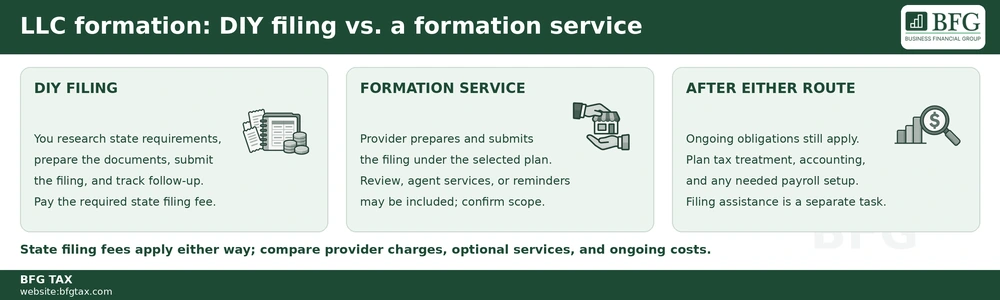
Either route can result in a valid LLC when the filing meets the state’s requirements and is accepted. The practical difference is who prepares and submits the documents, what assistance is included, and who manages the steps after approval.
LLC Formation Services vs DIY Filing
Consideration DIY Filing LLC Formation Service
Ownership and structural advice
You determine whether separate legal or tax advice is needed.
Basic filing assistance does not necessarily include legal or tax advice.
Filing the LLC
You research the requirements and prepare and submit the state filing yourself.
The service prepares and submits the filing under the relevant plan.
Time required
You handle the research, filing, and follow-up yourself.
May reduce your administrative work by handling the filing process for you.
Filing errors
You review the information before submitting it.
Provider review varies by service, and acceptance by the state is not guaranteed.
Registered agent
You may be eligible to serve as your own registered agent, subject to state rules.
A registered agent may be offered as part of the service or separately, depending on the provider and plan.
Ongoing compliance
You track applicable deadlines and requirements yourself.
Reminders or filing assistance may be available, depending on the provider and plan.
Upfront cost
State filing fee, plus any additional help or requirements that apply.
State filing fee plus the plan price and any add-ons.
Tax and accounting setup
Requires a separate decision and setup.
Usually outside basic filing assistance; confirm the provider’s scope.

Filing assistance and financial setup answer different questions. Whichever filing route you choose, you still need to consider how your LLC will be taxed and how its tax treatment will fit into your accounting, payroll, and financial processes.

LLC Formation Services vs DIY: What Each Option Actually Costs

Compare the state filing fee, the provider’s charges, any optional features, and the costs that continue after approval.
The State Filing Fee – the Same Either Way

The state charges a filing fee regardless of who submits the LLC formation documents. The amount and any processing charges vary by state and can change, so check the current fee with the state filing office before filing.

What a Formation Service Adds on Top
A formation service may charge for preparing and submitting the filing, registered-agent service, document templates, or ongoing reminders. A low advertised starting price may exclude features you need or apply only for an introductory period. Compare the full initial price and any recurring charges against the work you would otherwise handle yourself.
Ongoing Costs and Responsibilities
Forming an LLC is a one-time filing, but keeping it in good standing requires ongoing compliance with state requirements. Depending on the state, this may include recurring filings, fees, registered-agent requirements, or other compliance obligations. The specific requirements and deadlines vary by state, so business owners need to know what applies to their LLC and when.
  • Periodic state reports: Where required, these update the state’s records about the business. The filing schedule and any fee vary by state.
  • Registered agent: The agent is the person or business designated to receive legal documents and official notices on the LLC’s behalf. The LLC must maintain an agent who meets its state’s requirements. If you purchase agent service, check the renewal price.
Some states also charge a franchise tax, separate from the annual or biennial report fee. Missing these obligations can lead to penalties, loss of good standing, or administrative dissolution.
LLC approval does not end ongoing compliance. Confirm which responsibilities you will manage and which, if any, the provider has agreed to handle.

What Filing an LLC Yourself Requires and Where DIY Can Go Wrong

Choosing to form an LLC yourself means handling six key steps, from choosing a business name to maintaining compliance after approval. Each step is manageable, but small oversights can lead to rejected filings, delays, or compliance problems.
Checking Your Business Name
Your LLC’s name must be distinguishable from businesses already on file with the state. Checking the state’s business-name database before filing can help catch conflicts early. A name conflict can otherwise send the filing back and force you to start over.
Filing Your Articles of Organization
The Articles of Organization legally create the LLC and typically include its name, purpose, registered agent, and management structure. Missing information or inconsistent details can result in rejection. Even a small error in an address or required field can mean correcting and resubmitting the application.
Appointing a Registered Agent
An LLC generally needs a registered agent who meets its state’s address and availability requirements to receive legal notices. You may serve as your own agent if you meet those requirements, but your address may become part of the public record. Missing a notice can have legal consequences; maintain a reliable process for receiving and responding to notices.
Getting an EIN
An Employer Identification Number (EIN) identifies your business for federal tax purposes, and the IRS checklist for starting a business outlines the other federal steps to review. The EIN is free when obtained directly from the IRS. A bank may also request one when opening a business account, depending on its account-opening requirements.
Writing an Operating Agreement
An operating agreement outlines how the LLC will handle ownership, decisions, and finances. Even when not required by state law, it can prevent the state’s default rules from determining these matters. Without one, disagreements between owners can leave important decisions subject to those default rules.
Tracking Ongoing Compliance After Formation
Your responsibilities continue after approval. These may include filing annual reports, maintaining a registered agent, and keeping your business and agent information current. Missing applicable deadlines or requirements can result in penalties, loss of good standing, or administrative dissolution.

What a Formation Service Handles for You

A formation service can handle administrative steps involved in forming an LLC. Before paying, confirm whether the selected plan includes preparation of the state filing, review of your information, registered-agent service, or assistance with later filings.
The following features may be available, depending on the provider and plan.
Filing Accuracy and Error Prevention
  • Some providers review the information supplied before submitting the filing.
  • Confirm whether the selected plan includes a review for missing or inconsistent information.
  • This may reduce avoidable corrections, but state acceptance is not guaranteed.
Registered Agent and Privacy Protection
  • Registered-agent service may be included for a limited period or sold separately.
  • Using an agent’s address may limit disclosure of your home address in the agent field, but other filings may still require personal or business addresses.
  • It also gives your business a consistent point of contact for important legal notices.
Compliance Tracking After Formation
  • After approval, applicable state reports, fees, and other requirements still need to be tracked.
  • Some plans include reminders or assistance with later filings. Confirm which deadlines and filings are covered.
  • Evaluate the plan’s scope, price, and follow-up support against the responsibilities you can manage yourself.

If past filing problems have led to unresolved IRS notices, explore IRS Problem Resolution.

When DIY Filing Is the Right Call

Not everyone needs help forming an LLC. DIY filing can make sense when the business is straightforward, and you have the time to handle the requirements yourself.
  • Single-owner business: The LLC has one owner and no complicated ownership structure.
  • Formed in your home state: The business is being formed where you live and operate.
  • No outside investors: There are no investors or multiple ownership interests to account for.
  • Time to do the research: You can read your state’s requirements carefully rather than rushing through the filing.
  • Simple enough to manage yourself: The formation and ownership structure do not involve unusual legal or administrative requirements.

What Happens After the LLC Is Approved

State formation and federal tax treatment are separate decisions. An LLC’s default federal tax classification generally depends on its number of owners, and an eligible LLC may make a tax election. The appropriate tax treatment depends on the business’s circumstances and should be reviewed separately from the state filing. The IRS explains the options on its business structures page.

Connecting Your New Entity to Your Tax, Accounting, and Payroll Setup
  • Open a business bank account. This runs on the bank’s own separate review and account-opening process.
  • Complete licenses, permits, and tax registrations. Requirements vary by industry, location, and business activity.
  • Set up accounting and bookkeeping. Establish records for the new entity and coordinate them with any existing accounting system.
  • Set up payroll. If the business has employees, connect the new entity to its payroll setup.

If your business has multiple owners, employees, an existing entity, or growing financial complexity, BFG Tax’s Business Formation & Tax Strategy solution can help you evaluate how formation connects with tax planning, accounting, payroll, and reporting.

For the broader framework connecting formation with financial operations, explore Business Formation & Tax Strategy for Growing Businesses.
For coordinating the entity’s ongoing tax returns, explore Business Tax Preparation.
For planning hiring costs, cash needs, and growth, explore CFO Advisory Solutions.
Review how business income reaches your individual return with Personal Tax Preparation.
If your accounting workload exceeds your team’s capacity, explore BFG Talent Solutions.

For managing supplier payments alongside other business cash needs, explore Bill Payments (Accounts Payable).

How to Decide What’s Right for Your Business
Before choosing a filing route, or deciding whether an LLC formation service is worth it, consider three questions:

1. Is the filing straightforward?

A single owner forming an LLC in the state where the business operates may be comfortable following that state’s instructions directly.

2. What will a paid provider actually handle?

Compare what each service includes, such as document preparation, registered-agent arrangements, follow-up, later filing assistance, and the full initial and recurring price.

3. Do you need advice beyond filing?
Multiple owners, an existing business, employees, operations in more than one state, or uncertainty about tax treatment can require separate legal, tax, and financial decisions. A formation service may handle the paperwork, but it does not automatically resolve these issues.

Use the Business Formation and Tax Strategy Guide to organize the decisions beyond the filing.

Conclusion

DIY filing may suit a straightforward LLC when the owner can manage the state requirements. A paid formation service may reduce administrative work, but its scope must be checked. When ownership, tax treatment, or operations are more complex, review those decisions separately from the filing.

Frequently Asked Questions

Is a DIY LLC as legally valid as one filed through a service?

Yes. Preparing and submitting the documents yourself does not make an accepted LLC less valid. The filing must still satisfy the applicable state’s requirements.

How long does LLC formation take?

State processing times for LLC filings vary by state, filing method, and any expedited option available. Check the current processing estimate with your state filing office before submitting.

What happens if I make a mistake on my filing?

An incomplete or incorrect filing may need to be corrected and resubmitted. The correction method and any associated fee depend on the state and whether the issue is identified before or after the filing is accepted.

Can I switch to a formation service after filing DIY?

Yes. You can hire a provider after forming the LLC for eligible ongoing tasks, such as registered agent services or filing reminders. Changing a registered agent or correcting earlier information may require a separate state filing.

How do I form an LLC for a small business the right way?

There is no single right way, only the approach that matches the situation. A simple, single-owner business can often file directly with the state, while a business with employees, multiple owners, or plans to expand tends to benefit from professional guidance from the start.

Related BFG Tax Resources

Explore BFG Tax resources that connect entity choice with the systems required to support it:

Earlier-stage business?
Explore BFG Tax’s Business Formation and Tax Strategy Guide to understand the decisions beyond the filing.

Last reviewed: September 2026

Choose the Next Step for Your Business

Discuss Your Business Structure and Tax Planning

Choosing how to file your LLC is one decision. Understanding how it fits your taxes, accounting, payroll, and growth plans is another.
BFG Tax helps business owners consider these areas together. If you are adding owners, hiring employees, expanding operations, or reviewing your tax treatment, book a Strategy Session to discuss your current setup and what needs attention.

Have a question before booking?
Contact BFG Tax or call 844-BFG-4TAX.

What's the Difference Between Filing an LLC Yourself and Using a Formation Service?

Either route can result in a valid LLC when the filing meets the state’s requirements and is accepted. The practical difference is who prepares and submits the documents, what assistance is included, and who manages the steps after approval.
Consideration DIY Filing LLC Formation Service
Ownership and structural advice
You determine whether separate legal or tax advice is needed.
Basic filing assistance does not necessarily include legal or tax advice.
Filing the LLC
You research the requirements and prepare and submit the state filing yourself.
The service prepares and submits the filing under the relevant plan.
Time required
You handle the research, filing, and follow-up yourself.
May reduce your administrative work by handling the filing process for you.
Filing errors
You review the information before submitting it.
Provider review varies by service, and acceptance by the state is not guaranteed.
Registered agent
You may be eligible to serve as your own registered agent, subject to state rules.
A registered agent may be offered as part of the service or separately, depending on the provider and plan.
Ongoing compliance
You track applicable deadlines and requirements yourself.
Reminders or filing assistance may be available, depending on the provider and plan.
Upfront cost
State filing fee, plus any additional help or requirements that apply.
State filing fee plus the plan price and any add-ons.
Tax and accounting setup
Requires a separate decision and setup.
Usually outside basic filing assistance; confirm the provider’s scope.

Filing assistance and financial setup answer different questions. Whichever filing route you choose, you still need to consider how your LLC will be taxed and how its tax treatment will fit into your accounting, payroll, and financial processes.

LLC Formation Services vs DIY: What Each Option Actually Costs

Compare the state filing fee, the provider’s charges, any optional features, and the costs that continue after approval.
The State Filing Fee – the Same Either Way
The state charges a filing fee regardless of who submits the LLC formation documents. The amount and any processing charges vary by state and can change, so check the current fee with the state filing office before filing.
What a Formation Service Adds on Top
A formation service may charge for preparing and submitting the filing, registered-agent service, document templates, or ongoing reminders. A low advertised starting price may exclude features you need or apply only for an introductory period. Compare the full initial price and any recurring charges against the work you would otherwise handle yourself.
Ongoing Costs and Responsibilities
Forming an LLC is a one-time filing, but keeping it in good standing requires ongoing compliance with state requirements. Depending on the state, this may include recurring filings, fees, registered-agent requirements, or other compliance obligations. The specific requirements and deadlines vary by state, so business owners need to know what applies to their LLC and when.
  • Periodic state reports: Where required, these update the state’s records about the business. The filing schedule and any fee vary by state.
  • Registered agent: The agent is the person or business designated to receive legal documents and official notices on the LLC’s behalf. The LLC must maintain an agent who meets its state’s requirements. If you purchase agent service, check the renewal price.
Some states also charge a franchise tax, separate from the annual or biennial report fee. Missing these obligations can lead to penalties, loss of good standing, or administrative dissolution.
LLC approval does not end ongoing compliance. Confirm which responsibilities you will manage and which, if any, the provider has agreed to handle.

What Filing an LLC Yourself Requires and Where DIY Can Go Wrong

Choosing to form an LLC yourself means handling six key steps, from choosing a business name to maintaining compliance after approval. Each step is manageable, but small oversights can lead to rejected filings, delays, or compliance problems.
Checking Your Business Name
Your LLC’s name must be distinguishable from businesses already on file with the state. Checking the state’s business-name database before filing can help catch conflicts early. A name conflict can otherwise send the filing back and force you to start over.
Filing Your Articles of Organization
The Articles of Organization legally create the LLC and typically include its name, purpose, registered agent, and management structure. Missing information or inconsistent details can result in rejection. Even a small error in an address or required field can mean correcting and resubmitting the application.
Appointing a Registered Agent
An LLC generally needs a registered agent who meets its state’s address and availability requirements to receive legal notices. You may serve as your own agent if you meet those requirements, but your address may become part of the public record. Missing a notice can have legal consequences; maintain a reliable process for receiving and responding to notices.
Getting an EIN
An Employer Identification Number (EIN) identifies your business for federal tax purposes, and the IRS checklist for starting a business outlines the other federal steps to review. The EIN is free when obtained directly from the IRS. A bank may also request one when opening a business account, depending on its account-opening requirements.
Writing an Operating Agreement
An operating agreement outlines how the LLC will handle ownership, decisions, and finances. Even when not required by state law, it can prevent the state’s default rules from determining these matters. Without one, disagreements between owners can leave important decisions subject to those default rules.
Tracking Ongoing Compliance After Formation
Your responsibilities continue after approval. These may include filing annual reports, maintaining a registered agent, and keeping your business and agent information current. Missing applicable deadlines or requirements can result in penalties, loss of good standing, or administrative dissolution.

What a Formation Service Handles for You

A formation service can handle administrative steps involved in forming an LLC. Before paying, confirm whether the selected plan includes preparation of the state filing, review of your information, registered-agent service, or assistance with later filings.
The following features may be available, depending on the provider and plan.
Filing Accuracy and Error Prevention
  • Some providers review the information supplied before submitting the filing.
  • Confirm whether the selected plan includes a review for missing or inconsistent information.
  • This may reduce avoidable corrections, but state acceptance is not guaranteed.
Registered Agent and Privacy Protection
  • Registered-agent service may be included for a limited period or sold separately.
  • Using an agent’s address may limit disclosure of your home address in the agent field, but other filings may still require personal or business addresses.
  • It also gives your business a consistent point of contact for important legal notices.
Compliance Tracking After Formation
  • After approval, applicable state reports, fees, and other requirements still need to be tracked.
  • Some plans include reminders or assistance with later filings. Confirm which deadlines and filings are covered.
  • Evaluate the plan’s scope, price, and follow-up support against the responsibilities you can manage yourself.
If past filing problems have led to unresolved IRS notices, explore IRS Problem Resolution.

When DIY Filing Is the Right Call

Not everyone needs help forming an LLC. DIY filing can make sense when the business is straightforward, and you have the time to handle the requirements yourself.
  • Single-owner business: The LLC has one owner and no complicated ownership structure.
  • Formed in your home state: The business is being formed where you live and operate.
  • No outside investors: There are no investors or multiple ownership interests to account for.
  • Time to do the research: You can read your state’s requirements carefully rather than rushing through the filing.
  • Simple enough to manage yourself: The formation and ownership structure do not involve unusual legal or administrative requirements.

What Happens After the LLC Is Approved

State formation and federal tax treatment are separate decisions. An LLC’s default federal tax classification generally depends on its number of owners, and an eligible LLC may make a tax election. The appropriate tax treatment depends on the business’s circumstances and should be reviewed separately from the state filing. The IRS explains the options on its business structures page.

Connecting Your New Entity to Your Tax, Accounting, and Payroll Setup
  • Open a business bank account. This runs on the bank’s own separate review and account-opening process.
  • Complete licenses, permits, and tax registrations. Requirements vary by industry, location, and business activity.
  • Set up accounting and bookkeeping. Establish records for the new entity and coordinate them with any existing accounting system.
  • Set up payroll. If the business has employees, connect the new entity to its payroll setup.
If your business has multiple owners, employees, an existing entity, or growing financial complexity, BFG Tax’s Business Formation & Tax Strategy solution can help you evaluate how formation connects with tax planning, accounting, payroll, and reporting.
For the broader framework connecting formation with financial operations, explore Business Formation & Tax Strategy for Growing Businesses.

Related: Are Online LLC Formation Services Enough for Tax Planning?

For coordinating the entity’s ongoing tax returns, explore Business Tax Preparation.
For planning hiring costs, cash needs, and growth, explore CFO Advisory Solutions.
Review how business income reaches your individual return with Personal Tax Preparation.
If your accounting workload exceeds your team’s capacity, explore BFG Talent Solutions.
For managing supplier payments alongside other business cash needs, explore Bill Payments (Accounts Payable).
How to Decide What’s Right for Your Business
Before choosing a filing route, or deciding whether an LLC formation service is worth it, consider three questions:

1. Is the filing straightforward?

A single owner forming an LLC in the state where the business operates may be comfortable following that state’s instructions directly.

2. What will a paid provider actually handle?

Compare what each service includes, such as document preparation, registered-agent arrangements, follow-up, later filing assistance, and the full initial and recurring price.

3. Do you need advice beyond filing?
Multiple owners, an existing business, employees, operations in more than one state, or uncertainty about tax treatment can require separate legal, tax, and financial decisions. A formation service may handle the paperwork, but it does not automatically resolve these issues.
Use the Business Formation and Tax Strategy Guide to organize the decisions beyond the filing.

Conclusion

DIY filing may suit a straightforward LLC when the owner can manage the state requirements. A paid formation service may reduce administrative work, but its scope must be checked. When ownership, tax treatment, or operations are more complex, review those decisions separately from the filing.

Frequently Asked Questions

Is a DIY LLC as legally valid as one filed through a service?

Yes. Preparing and submitting the documents yourself does not make an accepted LLC less valid. The filing must still satisfy the applicable state’s requirements.

How long does LLC formation take?

State processing times for LLC filings vary by state, filing method, and any expedited option available. Check the current processing estimate with your state filing office before submitting.

What happens if I make a mistake on my filing?

An incomplete or incorrect filing may need to be corrected and resubmitted. The correction method and any associated fee depend on the state and whether the issue is identified before or after the filing is accepted.

Can I switch to a formation service after filing DIY?

Yes. You can hire a provider after forming the LLC for eligible ongoing tasks, such as registered agent services or filing reminders. Changing a registered agent or correcting earlier information may require a separate state filing.

How do I form an LLC for a small business the right way?

There is no single right way, only the approach that matches the situation. A simple, single-owner business can often file directly with the state, while a business with employees, multiple owners, or plans to expand tends to benefit from professional guidance from the start.

Related BFG Tax Resources

Explore BFG Tax resources that connect entity choice with the systems required to support it:

Earlier-stage business?
Explore BFG Tax’s Business Formation and Tax Strategy Guide to understand the decisions beyond the filing.

Last reviewed: September 2026

Choose the Next Step for Your Business

Discuss Your Business Structure and Tax Planning

Choosing how to file your LLC is one decision. Understanding how it fits your taxes, accounting, payroll, and growth plans is another.
BFG Tax helps business owners consider these areas together. If you are adding owners, hiring employees, expanding operations, or reviewing your tax treatment, book a Strategy Session to discuss your current setup and what needs attention.

Have a question before booking?
Contact BFG Tax or call 844-BFG-4TAX.

Related BFG Tax Resources

Disclaimer:
State requirements and tax treatment vary based on your specific facts and jurisdiction. This article provides general educational information and is not a substitute for individualized legal or tax advice.

Leave a Comment

Your email address will not be published. Required fields are marked *

Scroll to Top