
Best Business Structure for Service Businesses

Home » Blog » Best Business Structure for Service Businesses

Best Business Structure for Service Businesses

Choosing a business structure is one of the first decisions a service-business owner makes, but the right structure is not determined by how easy an entity is to form.
For a growing service business, the structure can affect federal tax treatment, owner compensation, payroll, ownership, liability, accounting, compliance, and how the business can change as it grows. A structure that works when the business is small may need to be reviewed as revenue, employees, owners, locations, or operational complexity increase.
The real question is not simply, “Which entity should I form?” It is whether the legal structure, tax treatment, ownership arrangement, accounting system, payroll setup, and compliance requirements work together for the business being built.
BFG Tax, a Business Financial Group company, helps business owners evaluate the financial and tax implications of formation and structure decisions through Business Formation and Tax Strategy. Legal questions and documents that require legal advice should be reviewed by a qualified attorney.

Best Business Structure for Service-Based Businesses That Plan to Scale

If you used an online LLC formation service, the service may have handled some of the administrative steps involved in forming your LLC. The exact scope depends on the provider and plan you selected.

What Makes a Business Structure Appropriate for a Growing Service Business?

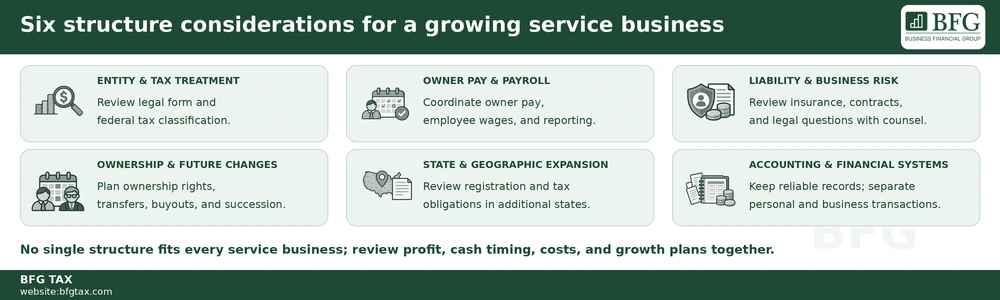
There is no single business structure that is automatically right for every service business.

A consultant, professional service firm, agency, contractor, healthcare business, or technology company may have different ownership, liability, compensation, payroll, financing, and expansion needs. The SBA notes that business structure can affect taxes, paperwork, personal liability, and the ability to raise money, while state rules can affect ownership, liability, taxes, and filing requirements.

For a service business planning to scale, the review should consider:
  • Current and expected profitability
  • Number and type of owners
  • Owner compensation
  • Employee and payroll plans
  • Liability considerations
  • State and local registration requirements
  • Federal tax treatment
  • Administrative and compliance costs
  • Plans to add owners or investors
  • Geographic expansion
  • Future ownership transfers or succession
The objective is not to select a structure based on one factor. It is to evaluate how the structure fits the business now and how it may need to support the business as it develops.

LLC, S Corporation, or Another Structure?
An LLC is a legal entity formed under state law; S corporation status is a federal tax election available to eligible entities. A service business can keep its LLC legal form while changing its federal tax treatment.
An LLC’s default federal tax treatment generally depends on its number of owners. Review whether that treatment fits the owners’ roles, expected profit, and plans to add partners.
S corporation treatment may be worth reviewing when consistent profit remains after reasonable owner compensation. Eligible ownership, payroll, tax filing, and administrative costs must also fit the business.
A corporation taxed as a C corporation may suit some outside-investment plans, but corporate income and shareholder dividends can both be taxed. Compare that tradeoff with the business’s financing and ownership goals.
Best Business Structure for Service Businesses

1. Evaluate the Legal Entity and Federal Tax Treatment

The first step is understanding the difference between the legal entity and federal tax classification.
A service business may operate as a sole proprietorship, partnership, LLC, or corporation. An LLC may also be eligible to elect corporate tax treatment, including S corporation treatment when the applicable requirements are met.

The review should consider:

  • Who owns the business
  • How ownership is divided
  • How profits and losses are allocated
  • How working owners will be compensated
  • Whether the owners expect to add investors or other owners
  • Whether the business expects to expand into additional states
  • What administrative requirements come with the structure
  • How the structure fits the business’s longer-term plans
The goal is not to find the structure with the lowest possible tax in isolation. Tax treatment should be considered alongside ownership, payroll, accounting, compliance, liability, and future business plans.

2. Coordinate Owner Compensation and Employee Payroll

Service businesses often depend heavily on the work performed by their owners. That makes owner compensation an important part of the structure discussion.

If an eligible business elects S corporation treatment, shareholder-employees who provide services generally must receive reasonable compensation before non-wage distributions are made. The IRS considers factors such as duties, responsibilities, time and effort, training and experience, compensation arrangements, and what comparable businesses pay for similar services.

This means an S corporation election should not be evaluated only by comparing potential tax treatment.
The business should also consider:
  • Payroll registration
  • Payroll processing
  • Federal and state withholding
  • Employment tax deposits
  • Payroll reporting
  • Year-end reporting
  • Accounting for wages and distributions
  • The owner’s actual role in generating business revenue
As the business hires employees, it also needs timely payroll registration, withholding, deposits, and reporting. Coordinate employee wages and owner pay with the accounting records before payroll begins; do not wait until year-end. For an S corporation election, compare any potential employment-tax benefit with the added payroll and administrative costs.
As the owner moves from delivering services to managing employees, compensation should reflect both roles. BFG Tax’s Payroll Solutions can help coordinate owner and employee pay with payroll reporting.

3. Review Liability and Business Risk

Service businesses can have different levels and types of risk.
A consulting firm, home healthcare agency, contractor, and technology company may face different contractual, operational, employment, and professional risks.
Business structure can provide different forms of legal protection, but entity formation does not eliminate every type of liability. The SBA notes that business structures differ in personal liability protections, and state rules can vary.
Business owners should therefore evaluate structure alongside:
  • Appropriate insurance
  • Contracts
  • Professional obligations
  • Employment practices
  • State requirements
  • Legal agreements
Questions about liability protection and legal documentation should be reviewed with a qualified attorney.

4. Consider Ownership and Future Changes

A structure that works for one owner may need to be reviewed when another owner joins.
A growing service business may eventually need to address:
  • Ownership percentages
  • Capital contributions
  • Voting authority
  • Management responsibilities
  • Profit distributions
  • Restrictions on ownership transfers
  • Buyout arrangements
  • Succession
  • What happens if an owner leaves, dies, becomes disabled, or disagrees with the other owners
These matters can affect the company’s legal documents, accounting records, tax reporting, and financial planning.
They may also require an operating agreement, partnership agreement, shareholder agreement, buy-sell agreement, or other legal documentation. Legal drafting and interpretation should be handled by an attorney.

5. Review State and Geographic Expansion

A service business planning to scale may eventually operate across state lines.
A business formed in one state may have additional registration or tax obligations in another state depending on its activities and connections there. State rules also vary regarding business taxes, annual reports, licenses, payroll, and entity treatment.
For example, a service business that adds employees in another state may need to review registration and payroll requirements before those employees begin working.
Expansion should therefore be considered before the business commits to a structure or assumes that its original state registration covers every future operation.

6. Establish Accounting and Financial Systems Early

The business structure should work with the accounting system rather than exist separately from it.
The accounting setup may need to distinguish:
  • Owner contributions
  • Owner draws or distributions
  • Loans
  • Payroll
  • Reimbursements
  • Equity accounts
  • Retained earnings
  • Business expenses
Business banking should also be established appropriately, with personal and business transactions kept separate.
As a service business grows, reliable accounting records become increasingly important for tax planning, cash-flow management, payroll, financial reporting, financing, and owner decision-making.

For a service business, customer payments may arrive after payroll is due. Review cash timing as well as profit before committing to regular owner pay or new hires. BFG Tax’s Accounting and Bookkeeping Solutions and Financial Systems Implementation can support reliable records and reporting; Proactive Tax Planning connects those records with tax decisions.

Example: A Growing Home Healthcare Agency

Consider a hypothetical home healthcare agency that begins with one owner and an LLC. It hires caregivers, so payroll must be set up and recorded accurately before wages are due. As profit becomes consistent, the owner reviews compensation and whether an S corporation election would justify its costs. A move into another state raises registration and payroll questions. If a second owner joins, ownership rights and tax treatment need another review, with an attorney handling the legal agreements. The original LLC may still fit; the point is to review each change before assuming that the formation paperwork covers it.

Conclusion

The best structure for a growing service business depends on how the business earns profit, pays its working owners, hires employees, and plans to expand. An LLC’s legal form and its federal tax treatment are separate decisions, and an S corporation election needs to justify its additional costs.
Review the structure before adding owners, employees, or operations in another state. Coordinate tax planning, payroll, accounting, and cash-flow needs, and involve an attorney when ownership agreements or liability questions require legal advice.

Frequently Asked Questions

What is the best business structure for a service business?

There is no single structure that is best for every service business. The appropriate structure depends on ownership, tax treatment, profitability, liability considerations, payroll, state requirements, administrative costs, and future plans.

Is an LLC a good structure for a service business?

An LLC can be appropriate for many service businesses, but the decision depends on the business’s circumstances. An LLC is a state-law entity and may have different federal tax classifications depending on ownership and elections.

When should a growing service business review its structure?

A review may be appropriate when profitability changes significantly, new owners are added, employees are hired, the business expands into another state, financing plans change, or the current structure no longer fits the company’s operations.

Related BFG Tax Resources

Explore these resources for coordinating structure, tax planning, and financial operations:

Earlier-stage business?
Explore BFG Tax’s Business Formation and Tax Strategy Guide to understand the decisions beyond the filing.

Last reviewed: September 2026

Choose the Next Step for Your Business

Choose the Next Step for Your Business

BFG works with growing businesses whose structure, payroll, accounting, and tax decisions need to be coordinated. The right scope depends on the business's complexity and the support it needs.

For a business evaluating its current or proposed structure, BFG Tax can review the tax, accounting, payroll, cash-flow, and financial implications and help identify when additional legal review may be appropriate.

Have a question before booking?
Contact BFG Tax or call 844-BFG-4TAX.

Best Business Structure for Service-Based Businesses That Plan to Scale

If you used an online LLC formation service, the service may have handled some of the administrative steps involved in forming your LLC. The exact scope depends on the provider and plan you selected.

What Makes a Business Structure Appropriate for a Growing Service Business?

There is no single business structure that is automatically right for every service business.

A consultant, professional service firm, agency, contractor, healthcare business, or technology company may have different ownership, liability, compensation, payroll, financing, and expansion needs. The SBA notes that business structure can affect taxes, paperwork, personal liability, and the ability to raise money, while state rules can affect ownership, liability, taxes, and filing requirements.

For a service business planning to scale, the review should consider:
  • Current and expected profitability
  • Number and type of owners
  • Owner compensation
  • Employee and payroll plans
  • Liability considerations
  • State and local registration requirements
  • Federal tax treatment
  • Administrative and compliance costs
  • Plans to add owners or investors
  • Geographic expansion
  • Future ownership transfers or succession
The objective is not to select a structure based on one factor. It is to evaluate how the structure fits the business now and how it may need to support the business as it develops.

LLC, S Corporation, or Another Structure?

An LLC is a legal entity formed under state law; S corporation status is a federal tax election available to eligible entities. A service business can keep its LLC legal form while changing its federal tax treatment.
An LLC’s default federal tax treatment generally depends on its number of owners. Review whether that treatment fits the owners’ roles, expected profit, and plans to add partners.
S corporation treatment may be worth reviewing when consistent profit remains after reasonable owner compensation. Eligible ownership, payroll, tax filing, and administrative costs must also fit the business.
A corporation taxed as a C corporation may suit some outside-investment plans, but corporate income and shareholder dividends can both be taxed. Compare that tradeoff with the business’s financing and ownership goals.
Best Business Structure for Service Businesses

1. Evaluate the Legal Entity and Federal Tax Treatment

The first step is understanding the difference between the legal entity and federal tax classification.
A service business may operate as a sole proprietorship, partnership, LLC, or corporation. An LLC may also be eligible to elect corporate tax treatment, including S corporation treatment when the applicable requirements are met.

The review should consider:

  • Who owns the business
  • How ownership is divided
  • How profits and losses are allocated
  • How working owners will be compensated
  • Whether the owners expect to add investors or other owners
  • Whether the business expects to expand into additional states
  • What administrative requirements come with the structure
  • How the structure fits the business’s longer-term plans
The goal is not to find the structure with the lowest possible tax in isolation. Tax treatment should be considered alongside ownership, payroll, accounting, compliance, liability, and future business plans.

2. Coordinate Owner Compensation and Employee Payroll

Service businesses often depend heavily on the work performed by their owners. That makes owner compensation an important part of the structure discussion.

If an eligible business elects S corporation treatment, shareholder-employees who provide services generally must receive reasonable compensation before non-wage distributions are made. The IRS considers factors such as duties, responsibilities, time and effort, training and experience, compensation arrangements, and what comparable businesses pay for similar services.

This means an S corporation election should not be evaluated only by comparing potential tax treatment.
The business should also consider:
  • Payroll registration
  • Payroll processing
  • Federal and state withholding
  • Employment tax deposits
  • Payroll reporting
  • Year-end reporting
  • Accounting for wages and distributions
  • The owner’s actual role in generating business revenue
As the business hires employees, it also needs timely payroll registration, withholding, deposits, and reporting. Coordinate employee wages and owner pay with the accounting records before payroll begins; do not wait until year-end. For an S corporation election, compare any potential employment-tax benefit with the added payroll and administrative costs.
As the owner moves from delivering services to managing employees, compensation should reflect both roles. BFG Tax’s Payroll Solutions can help coordinate owner and employee pay with payroll reporting.

3. Review Liability and Business Risk

Service businesses can have different levels and types of risk.
A consulting firm, home healthcare agency, contractor, and technology company may face different contractual, operational, employment, and professional risks.
Business structure can provide different forms of legal protection, but entity formation does not eliminate every type of liability. The SBA notes that business structures differ in personal liability protections, and state rules can vary.
Business owners should therefore evaluate structure alongside:
  • Appropriate insurance
  • Contracts
  • Professional obligations
  • Employment practices
  • State requirements
  • Legal agreements
Questions about liability protection and legal documentation should be reviewed with a qualified attorney.

4. Consider Ownership and Future Changes

A structure that works for one owner may need to be reviewed when another owner joins.
A growing service business may eventually need to address:
  • Ownership percentages
  • Capital contributions
  • Voting authority
  • Management responsibilities
  • Profit distributions
  • Restrictions on ownership transfers
  • Buyout arrangements
  • Succession
  • What happens if an owner leaves, dies, becomes disabled, or disagrees with the other owners
These matters can affect the company’s legal documents, accounting records, tax reporting, and financial planning.
They may also require an operating agreement, partnership agreement, shareholder agreement, buy-sell agreement, or other legal documentation. Legal drafting and interpretation should be handled by an attorney.

5. Review State and Geographic Expansion

A service business planning to scale may eventually operate across state lines.
A business formed in one state may have additional registration or tax obligations in another state depending on its activities and connections there. State rules also vary regarding business taxes, annual reports, licenses, payroll, and entity treatment.
For example, a service business that adds employees in another state may need to review registration and payroll requirements before those employees begin working.
Expansion should therefore be considered before the business commits to a structure or assumes that its original state registration covers every future operation.

6. Establish Accounting and Financial Systems Early

The business structure should work with the accounting system rather than exist separately from it.
The accounting setup may need to distinguish:
  • Owner contributions
  • Owner draws or distributions
  • Loans
  • Payroll
  • Reimbursements
  • Equity accounts
  • Retained earnings
  • Business expenses
Business banking should also be established appropriately, with personal and business transactions kept separate.
As a service business grows, reliable accounting records become increasingly important for tax planning, cash-flow management, payroll, financial reporting, financing, and owner decision-making.

For a service business, customer payments may arrive after payroll is due. Review cash timing as well as profit before committing to regular owner pay or new hires. BFG Tax’s Accounting and Bookkeeping Solutions and Financial Systems Implementation can support reliable records and reporting; Proactive Tax Planning connects those records with tax decisions.

Example: A Growing Home Healthcare Agency

Consider a hypothetical home healthcare agency that begins with one owner and an LLC. It hires caregivers, so payroll must be set up and recorded accurately before wages are due. As profit becomes consistent, the owner reviews compensation and whether an S corporation election would justify its costs. A move into another state raises registration and payroll questions. If a second owner joins, ownership rights and tax treatment need another review, with an attorney handling the legal agreements. The original LLC may still fit; the point is to review each change before assuming that the formation paperwork covers it.

Conclusion

The best structure for a growing service business depends on how the business earns profit, pays its working owners, hires employees, and plans to expand. An LLC’s legal form and its federal tax treatment are separate decisions, and an S corporation election needs to justify its additional costs.
Review the structure before adding owners, employees, or operations in another state. Coordinate tax planning, payroll, accounting, and cash-flow needs, and involve an attorney when ownership agreements or liability questions require legal advice.

Frequently Asked Questions

What is the best business structure for a service business?

There is no single structure that is best for every service business. The appropriate structure depends on ownership, tax treatment, profitability, liability considerations, payroll, state requirements, administrative costs, and future plans.

Is an LLC a good structure for a service business?

An LLC can be appropriate for many service businesses, but the decision depends on the business’s circumstances. An LLC is a state-law entity and may have different federal tax classifications depending on ownership and elections.

When should a growing service business review its structure?

A review may be appropriate when profitability changes significantly, new owners are added, employees are hired, the business expands into another state, financing plans change, or the current structure no longer fits the company’s operations.

Related BFG Tax Resources

Explore these resources for coordinating structure, tax planning, and financial operations:

Earlier-stage business?
Explore BFG Tax’s Business Formation and Tax Strategy Guide to understand the decisions beyond the filing.

Last reviewed: September 2026

Choose the Next Step for Your Business

Choose the Next Step for Your Business

BFG works with growing businesses whose structure, payroll, accounting, and tax decisions need to be coordinated. The right scope depends on the business's complexity and the support it needs.

For a business evaluating its current or proposed structure, BFG Tax can review the tax, accounting, payroll, cash-flow, and financial implications and help identify when additional legal review may be appropriate.

Have a question before booking?
Contact BFG Tax or call 844-BFG-4TAX.

Related BFG Tax Resources

Disclaimer:
This article provides general educational information and does not constitute legal, tax, payroll, accounting, or financial advice. Business structure, tax treatment, registration, and compliance requirements depend on each business’s circumstances and applicable laws. Consult qualified legal and tax professionals before forming or changing a business structure or making a tax election.

Leave a Comment

Your email address will not be published. Required fields are marked *

Scroll to Top