


Are Online LLC Formation Services
Enough for Tax Planning?

A basic online limited liability company (LLC) formation package generally handles filing and administrative tasks. It should not be assumed to include individualized tax planning. Check whether the provider offers qualified tax advice, what the plan includes, and which decisions remain your responsibility.
Once the business is established, the focus shifts from creating the entity to running it. This is where LLC formation and tax planning begin to intersect. You now have to make decisions about how the business will be taxed, what records you need to maintain, how taxes will be paid, and what changes when the business begins generating income or hiring employees. These decisions should be considered before formation where possible and reviewed as the business begins operating or changes.
Forming an LLC creates the legal entity under state law. For federal tax purposes, the LLC receives a default classification based on its ownership, and whether that default fits your business is a separate question. A clear LLC tax strategy can help you understand your options, make informed decisions, and address tax requirements before they become more complicated.
Table of contents
- What Does an Online LLC Formation Service Actually Handle?
- What Tax Decisions Remain After Forming an LLC?
- What Can Happen If These Tax Decisions Are Overlooked?
- When Should You Consider Professional Tax Planning?
- How Do You Decide What Your Business Needs?
- Conclusion
- Frequently Asked Questions
- Related BFG Tax Resources
- Review the Tax Decisions Beyond Your LLC Filing
What Does an Online LLC Formation Service Actually Handle?
What the LLC Formation Service May Handle
- State formation filing: Prepares and files the documents required by the state to form your LLC.
- Formation documents: Helps prepare documents such as the Articles of Organization.
- EIN application: May assist with the EIN application to the IRS.
- Registered agent: May provide or arrange registered-agent services.
- Other formation requirements: May assist with additional administrative requirements, depending on the provider and plan.
What Tax Decisions Remain After Forming an LLC?
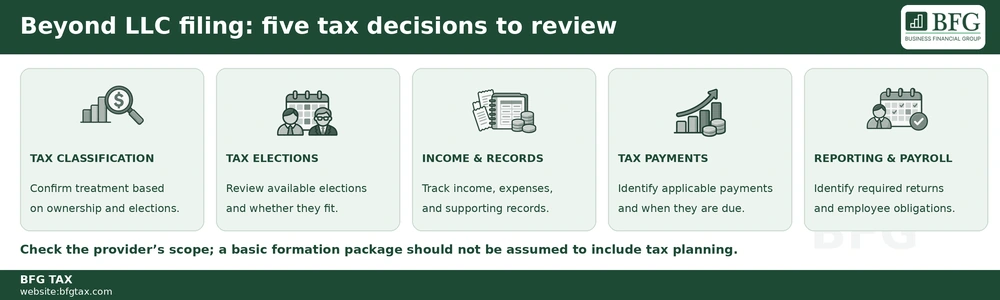
- Tax classification: An LLC’s federal tax classification depends on factors such as its ownership and any elections it makes.
- Tax elections: An eligible LLC may be able to elect a different federal tax classification, such as S corporation treatment. Whether an election is appropriate depends on the business and its circumstances.
- Income and deductions: Track business income, expenses, and supporting records throughout the year. These records support accurate tax reporting and help identify potentially deductible business expenses.
- Tax payments: Determine which tax payments apply to your business and when they are due. Depending on your circumstances, this may include estimated tax payments.
- Reporting and payroll: Identify the tax returns and reporting requirements that apply to your business. Hiring employees can also create payroll withholding, tax, and reporting responsibilities.
For an overview of ongoing planning, explore the Proactive Tax Planning Guide.
Review how business income reaches your individual return with Personal Tax Preparation.
What Can Happen If These Tax Decisions Are Overlooked?
| What can be overlooked | What can happen | What this can mean for your business |
|---|---|---|
How your LLC is taxed |
Your LLC may be taxed differently from what you expected. |
You may need to reassess whether your current tax treatment fits your business. |
Tax elections |
You may overlook an available election or make one without considering whether it fits your circumstances. |
You may need to review whether a different election is appropriate for your business. |
Incomplete records can make it harder to track income, expenses, and potentially deductible costs. |
You may have a less accurate view of your financial position and tax obligations. | |
Tax payments |
You may face a tax payment that is higher than the amount you set aside. |
Your cash flow may be affected by an unexpected tax payment. |
Payroll |
Hiring employees can create additional withholding, payment, and reporting responsibilities. |
You may need to establish additional payroll processes and meet new obligations. |
Tax reporting |
A required filing may be missed, delayed, or require correction. |
You may have additional compliance work and may need to correct the filing. |
Changes as you grow |
Changes in revenue, employees, ownership, or operations may create new tax and reporting considerations. |
Your existing tax and financial setup may need to be reviewed as the business changes. |
Explore the Cash Flow Management Guide for planning business payments and cash needs.
If past filing problems have led to unresolved IRS notices, explore IRS Problem Resolution. For managing supplier payments alongside other business cash needs, explore Bill Payments (Accounts Payable).
Forming an LLC handles the legal formation of the business, but it does not determine every tax decision that follows. Proactive tax planning becomes more relevant when changes in your business can affect your tax treatment, payments, or reporting obligations.
- You are unsure how your LLC should be taxed. Your federal tax treatment depends on factors such as ownership and any tax elections available to the LLC.
- You are considering an S corporation election. An eligible LLC may elect S corporation treatment, but the decision involves tax and payroll considerations that depend on the business.
- Your income or business activity is growing. Changes in income, operations, or profitability may affect your tax obligations and planning needs.
- You are hiring employees. Employees introduce payroll withholding, payroll tax, and reporting responsibilities.
- You are expanding into another state. Operating in multiple states may create additional registration, tax, and reporting requirements.
- Your ownership or business structure is changing. Adding owners or changing how the business operates can affect its tax and financial setup.
- Your records are not keeping pace with the business. Accurate bookkeeping supports tax reporting and helps you understand the financial position of the business.
For planning hiring costs, cash needs, and growth, explore CFO Advisory Solutions.
If your accounting workload exceeds your team’s capacity, explore BFG Talent Solutions.
How Do You Decide What Your Business Needs?
3. Has my business become more complex?
Consider whether you now have multiple owners, employees, higher income, operations in multiple states, or other changes that affect your tax and reporting obligations.
Conclusion
Frequently Asked Questions
1. Are online LLC formation services enough for tax planning?
2. What should I do after forming an LLC to make sure my tax strategy is in place?
3. Does forming an LLC automatically mean the business is ready to operate financially?
4. Do I need to change my LLC tax strategy if my business starts growing?
5. Is an S corporation election automatically better for an LLC?
Related BFG Tax Resources
Explore BFG Tax resources that connect formation and tax decisions with the financial systems needed to support them:
Earlier-stage business?
Explore BFG Tax’s Business Formation and Tax Strategy Guide to understand the decisions beyond the filing.
Choose the Next Step for Your Business
Review the Tax Decisions Beyond Your LLC Filing
For an established or growing business, LLC formation, tax treatment, bookkeeping, payroll, and reporting need to work together. BFG Tax's Business Formation & Tax Strategy solution can help you evaluate these decisions in the context of your business.
If you have unresolved tax questions or increasing financial complexity, book a Strategy Session to discuss your current setup and the appropriate next step.
Have a question before booking?
Contact BFG Tax or call 844-BFG-4TAX.
Table of contents
- What Does an Online LLC Formation Service Actually Handle?
- What Tax Decisions Remain After Forming an LLC?
- What Can Happen If These Tax Decisions Are Overlooked?
- When Should You Consider Professional Tax Planning?
- How Do You Decide What Your Business Needs?
- Conclusion
- Frequently Asked Questions
- Related BFG Tax Resources
- Review the Tax Decisions Beyond Your LLC Filing
What Does an Online LLC Formation Service Actually Handle?
If you used an online LLC formation service, the service may have handled some of the administrative steps involved in forming your LLC. The exact scope depends on the provider and plan you selected.
What the LLC Formation Service May Handle
- State formation filing: Prepares and files the documents required by the state to form your LLC.
- Formation documents: Helps prepare documents such as the Articles of Organization.
- EIN application: May assist with the EIN application to the IRS.
- Registered agent: May provide or arrange registered-agent services.
- Other formation requirements: May assist with additional administrative requirements, depending on the provider and plan.
What Tax Decisions Remain After Forming an LLC?
- Tax classification: An LLC’s federal tax classification depends on factors such as its ownership and any elections it makes.
- Tax elections: An eligible LLC may be able to elect a different federal tax classification, such as S corporation treatment. Whether an election is appropriate depends on the business and its circumstances.
- Income and deductions: Track business income, expenses, and supporting records throughout the year. These records support accurate tax reporting and help identify potentially deductible business expenses.
- Tax payments: Determine which tax payments apply to your business and when they are due. Depending on your circumstances, this may include estimated tax payments.
- Reporting and payroll: Identify the tax returns and reporting requirements that apply to your business. Hiring employees can also create payroll withholding, tax, and reporting responsibilities.
For an overview of ongoing planning, explore the Proactive Tax Planning Guide.
Review how business income reaches your individual return with Personal Tax Preparation.
What Can Happen If These Tax Decisions Are Overlooked?
They may affect your cash flow, create additional reporting or compliance work, or require you to revisit decisions as the business changes.
| What can be overlooked | What can happen | What this can mean for your business |
|---|---|---|
How your LLC is taxed |
Your LLC may be taxed differently from what you expected. |
You may need to reassess whether your current tax treatment fits your business. |
Tax elections |
You may overlook an available election or make one without considering whether it fits your circumstances. |
You may need to review whether a different election is appropriate for your business. |
Incomplete records can make it harder to track income, expenses, and potentially deductible costs. |
You may have a less accurate view of your financial position and tax obligations. | |
Tax payments |
You may face a tax payment that is higher than the amount you set aside. |
Your cash flow may be affected by an unexpected tax payment. |
Payroll |
Hiring employees can create additional withholding, payment, and reporting responsibilities. |
You may need to establish additional payroll processes and meet new obligations. |
Tax reporting |
A required filing may be missed, delayed, or require correction. |
You may have additional compliance work and may need to correct the filing. |
Changes as you grow |
Changes in revenue, employees, ownership, or operations may create new tax and reporting considerations. |
Your existing tax and financial setup may need to be reviewed as the business changes. |
Explore the Cash Flow Management Guide for planning business payments and cash needs.
If past filing problems have led to unresolved IRS notices, explore IRS Problem Resolution. For managing supplier payments alongside other business cash needs, explore Bill Payments (Accounts Payable).
Forming an LLC handles the legal formation of the business, but it does not determine every tax decision that follows. Proactive tax planning becomes more relevant when changes in your business can affect your tax treatment, payments, or reporting obligations.
Consider professional tax planning when:
- You are unsure how your LLC should be taxed. Your federal tax treatment depends on factors such as ownership and any tax elections available to the LLC.
- You are considering an S corporation election. An eligible LLC may elect S corporation treatment, but the decision involves tax and payroll considerations that depend on the business.
- Your income or business activity is growing. Changes in income, operations, or profitability may affect your tax obligations and planning needs.
- You are hiring employees. Employees introduce payroll withholding, payroll tax, and reporting responsibilities.
- You are expanding into another state. Operating in multiple states may create additional registration, tax, and reporting requirements.
- Your ownership or business structure is changing. Adding owners or changing how the business operates can affect its tax and financial setup.
- Your records are not keeping pace with the business. Accurate bookkeeping supports tax reporting and helps you understand the financial position of the business.
For the broader formation framework, explore Business Formation & Tax Strategy for Growing Businesses.
For planning hiring costs, cash needs, and growth, explore CFO Advisory Solutions.
If your accounting workload exceeds your team’s capacity, explore BFG Talent Solutions.
How Do You Decide What Your Business Needs?
Make sure you understand your LLC’s tax classification, available tax elections, recordkeeping, tax payments, payroll, and reporting requirements.
3. Has my business become more complex?
Consider whether you now have multiple owners, employees, higher income, operations in multiple states, or other changes that affect your tax and reporting obligations.
The goal is not to choose between an LLC formation service and a tax professional. First, establish what has already been handled, identify what remains, and then determine where additional expertise or support is needed.
Conclusion
Frequently Asked Questions
1. Are online LLC formation services enough for tax planning?
2. What should I do after forming an LLC to make sure my tax strategy is in place?
3. Does forming an LLC automatically mean the business is ready to operate financially?
4. Do I need to change my LLC tax strategy if my business starts growing?
5. Is an S corporation election automatically better for an LLC?
Related BFG Tax Resources
Explore BFG Tax resources that connect formation and tax decisions with the financial systems needed to support them:
Earlier-stage business?
Explore BFG Tax’s Business Formation and Tax Strategy Guide to understand the decisions beyond the filing.
Choose the Next Step for Your Business
Review the Tax Decisions Beyond Your LLC Filing
For an established or growing business, LLC formation, tax treatment, bookkeeping, payroll, and reporting need to work together. BFG Tax's Business Formation & Tax Strategy solution can help you evaluate these decisions in the context of your business.
If you have unresolved tax questions or increasing financial complexity, book a Strategy Session to discuss your current setup and the appropriate next step.
Have a question before booking?
Contact BFG Tax or call 844-BFG-4TAX.
Related BFG Tax Resources
This article provides general educational information and is not a substitute for individualized legal or tax advice. Federal and state requirements and tax treatment depend on the business’s specific facts and jurisdiction.