


Startup Tax Planning Mistakes That
Create Bigger Problems Later

Startup tax planning helps owners review tax treatment, estimated payments, records, payroll, and state obligations before deadlines are missed. These practical checks can help you identify gaps early and keep tax decisions aligned with how your business operates.
Why Do Small Startup Tax Mistakes Grow Into Bigger Problems?
- It repeats. The same gap, such as an unrecorded expense, occurs every month.
- It compounds. New employees, owners, and states add rules on top of the original gap.
- It can limit your options. Some elections and planning decisions have deadlines. Missing one may delay a change or require additional steps to seek relief.
Check: Confirm your current federal tax classification and discuss whether it remains appropriate for your ownership, profitability, and plans. Identify any relevant election deadlines.
The mistake: The owner treats all business cash as spendable and considers tax only at filing time.
Why it grows: Depending on the taxpayer and business structure, income taxes may need to be paid during the year through estimated payments or withholding. Inadequate payments can create cash flow pressure and may result in underpayment penalties.
Check: Determine which estimated payment or withholding rules apply to you, review due dates, and plan cash reserves around projected obligations.
The mistake: Using the same account or card for personal and business spending.
Why it grows: Mixed personal and business transactions take time to separate and can make deductions harder to support. Organized records help you identify business activity and explain the figures on your return.
Check: Maintain separate, traceable business records and use a dedicated business account where appropriate or required. Record owner withdrawals and contributions according to the entity’s tax treatment.
The mistake: The owner gathers receipts, invoices, and payroll records once a year.
Why it grows: Records support the income and deductions on a return. Missing records are hard to rebuild. A gap can leave the business unable to show what supports a figure.
Check: Confirm that you record income, expenses, and supporting documents as they happen, in one place.
For help organizing formation decisions and financial responsibilities, explore the Business Formation and Tax Strategy Guide.
The mistake: The business does not evaluate whether workers are employees or independent contractors, or overlooks the separate rules governing owner compensation.
Why it grows: Worker classification affects payroll tax withholding, deposits, and reporting. Incorrect classification may result in additional tax liabilities and penalties. Owner compensation must also be evaluated according to the business’s tax treatment.
6. Ignoring State and Local Startup Tax Compliance
The mistake: The business plans for federal tax only.
Why it grows: State and local registration, tax, and filing requirements can differ depending on where a business operates, employs people, or makes sales. Expansion may create additional obligations. Verify the applicable requirements with the relevant state or local tax and registration authorities before acting.
Check: List the states and cities where the business operates, sells, or employs people. Find out whether it must register or file in each one.
7. Treating Tax as a Once-a-Year Task
The mistake: The owner reviews tax only when the return is due, after the year has ended.
Why it grows: Certain tax elections and planning decisions have specific deadlines. Missing them may limit available options, delay a change, or require additional steps to seek relief, depending on the circumstances.
Check: Review projected profit, required payments, and decisions with approaching deadlines during the year. Proactive Tax Planning helps connect those reviews with accounting, payroll, and cash needs.
Which Startup Tax Planning Mistakes Apply to Your Business?
- Have you reviewed how the business is taxed since you started?
- Have you reviewed required tax payments and planned how to fund them?
- Are business and personal transactions kept separate and traceable?
- Are your records current, not saved for tax time?
- Do you know how each worker is classified and how you pay yourself?
- Do you know which states you must register or file in?
- Does someone review your tax position during the year and before important deadlines?
What Are Your Options for Fixing Startup Tax Mistakes?
Conclusion
Frequently Asked Questions
What are the common startup tax planning mistakes?
How can I avoid tax problems when starting a business?
Confirm how the business is taxed, keep personal and business transactions separate, and maintain current records. Review required tax payments and payroll obligations before deadlines, and reassess the setup when ownership, staffing, locations, or income change.
When should new business tax planning start?
Do I need a professional for tax planning for a new business?
How often should a growing startup review its tax strategy?
Related BFG Tax Resources
Earlier-stage business?
Explore BFG Tax’s Business Formation and Tax Strategy Guide to understand the decisions beyond the filing.
Choose the Next Step for Your Business
Discuss Your Startup Tax Strategy
For a growing startup managing employees, owners, or operations in more than one state, tax decisions need to work with accounting, payroll, and cash flow. In BFG Tax’s 30- to 45-minute virtual Strategy Session, we discuss your current setup, goals, and challenges and recommend an appropriate next step. If you are still organizing an early-stage business, start with the Business Formation and Tax Strategy Guide.
Have a question before booking?
Contact BFG Tax or call 844-BFG-4TAX.
Why Do Small Startup Tax Mistakes Grow Into Bigger Problems?
A small mistake grows in three ways:
- It repeats. The same gap, such as an unrecorded expense, occurs every month.
- It compounds. New employees, owners, and states add rules on top of the original gap.
- It can limit your options. Some elections and planning decisions have deadlines. Missing one may delay a change or require additional steps to seek relief.
Startup tax planning means making those decisions on purpose. It covers how the business is taxed, how it pays tax, and how it keeps records and files returns.
Each mistake includes a practical check you can use to review your current setup.
1. Not Reviewing Your Default Tax Treatment
The mistake: The business keeps the tax classification it received at formation and never reviews it.
Why it grows: A business’s default federal tax classification may be appropriate at formation, but changing profits, ownership, or operations may justify reviewing other eligible tax treatments. Elections can have eligibility rules, filing deadlines, and ongoing administrative or compensation requirements.
Check: Confirm your current federal tax classification and discuss whether it remains appropriate for your ownership, profitability, and plans. Identify any relevant election deadlines.
2. Not Setting Money Aside for Taxes
The mistake: The owner treats all business cash as spendable and considers tax only at filing time.
Why it grows: Depending on the taxpayer and business structure, income taxes may need to be paid during the year through estimated payments or withholding. Inadequate payments can create cash flow pressure and may result in underpayment penalties.
Check: Determine which estimated payment or withholding rules apply to you, review due dates, and plan cash reserves around projected obligations.
3. Mixing Personal and Business Money
The mistake: Using the same account or card for personal and business spending.
Why it grows: Mixed personal and business transactions take time to separate and can make deductions harder to support. Organized records help you identify business activity and explain the figures on your return.
Check: Maintain separate, traceable business records and use a dedicated business account where appropriate or required. Record owner withdrawals and contributions according to the entity’s tax treatment.
4. Keeping Records Only at Tax Time
The mistake: The owner gathers receipts, invoices, and payroll records once a year.
Why it grows: Records support the income and deductions on a return. Missing records are hard to rebuild. A gap can leave the business unable to show what supports a figure.
Check: Confirm that you record income, expenses, and supporting documents as they happen, in one place.
For help organizing formation decisions and financial responsibilities, explore the Business Formation and Tax Strategy Guide.
5. Getting Payroll Wrong
The mistake: The business does not evaluate whether workers are employees or independent contractors, or overlooks the separate rules governing owner compensation.
Why it grows: Worker classification affects payroll tax withholding, deposits, and reporting. Incorrect classification may result in additional tax liabilities and penalties. Owner compensation must also be evaluated according to the business’s tax treatment.
6. Ignoring State and Local Startup Tax Compliance
The mistake: The business plans for federal tax only.
Why it grows: State and local registration, tax, and filing requirements can differ depending on where a business operates, employs people, or makes sales. Expansion may create additional obligations. Verify the applicable requirements with the relevant state or local tax and registration authorities before acting.
Check: List the states and cities where the business operates, sells, or employs people. Find out whether it must register or file in each one.
7. Treating Tax as a Once-a-Year Task
The mistake: The owner reviews tax only when the return is due, after the year has ended.
Why it grows: Certain tax elections and planning decisions have specific deadlines. Missing them may limit available options, delay a change, or require additional steps to seek relief, depending on the circumstances.
Check: Review projected profit, required payments, and decisions with approaching deadlines during the year. Proactive Tax Planning helps connect those reviews with accounting, payroll, and cash needs.
These mistakes overlap, and weak records make payroll and estimated tax harder to get right. The check below shows which ones apply to you.
Which Startup Tax Planning Mistakes Apply to Your Business?
Answer these seven questions with yes, no, or not sure. A “no” or “not sure” identifies an area to review using the corresponding checks above.
- Have you reviewed how the business is taxed since you started?
- Have you reviewed required tax payments and planned how to fund them?
- Are business and personal transactions kept separate and traceable?
- Are your records current, not saved for tax time?
- Do you know how each worker is classified and how you pay yourself?
- Do you know which states you must register or file in?
- Does someone review your tax position during the year and before important deadlines?
Use these answers to identify which issues need attention. A single issue involving worker classification, filing obligations, or an approaching deadline may warrant professional review, even if other areas are in good order.
What Are Your Options for Fixing Startup Tax Mistakes?
Depending on the issue, you may handle routine recordkeeping internally, engage a bookkeeper or accountant for specific tasks, or seek coordinated tax planning advice. Choose support based on the complexity and consequences of what you should do next.
Review the seven checks and prioritize gaps that could affect compliance, cash flow, or upcoming decisions. Some issues can be addressed through better records and a regular review schedule; others may call for professional guidance. BFG Tax, a Business Financial Group company, helps coordinate tax planning with accounting, payroll, and financial decisions.
Conclusion
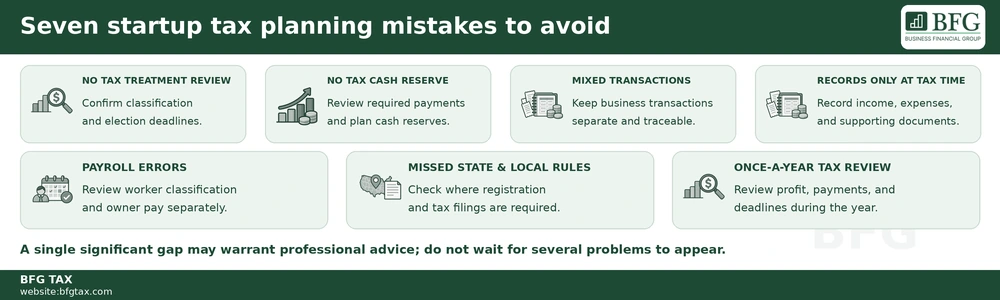
Startup tax planning requires current records, timely payments, and reviews when the business changes. Review your tax classification, payroll responsibilities, state obligations, and approaching deadlines together. A single significant gap may warrant professional advice; you do not need to wait until several problems appear.
Frequently Asked Questions
What are the common startup tax planning mistakes?
How can I avoid tax problems when starting a business?
Confirm how the business is taxed, keep personal and business transactions separate, and maintain current records. Review required tax payments and payroll obligations before deadlines, and reassess the setup when ownership, staffing, locations, or income change.
When should new business tax planning start?
Do I need a professional for tax planning for a new business?
How often should a growing startup review its tax strategy?
Related BFG Tax Resources
Explore these BFG Tax resources for practical guidance and coordinated financial support:
Earlier-stage business?
Explore BFG Tax’s Business Formation and Tax Strategy Guide to understand the decisions beyond the filing.
Choose the Next Step for Your Business
Discuss Your Startup Tax Strategy
For a growing startup managing employees, owners, or operations in more than one state, tax decisions need to work with accounting, payroll, and cash flow. In BFG Tax’s 30- to 45-minute virtual Strategy Session, we discuss your current setup, goals, and challenges and recommend an appropriate next step. If you are still organizing an early-stage business, start with the Business Formation and Tax Strategy Guide.
Have a question before booking?
Contact BFG Tax or call 844-BFG-4TAX.
Related BFG Tax Resources
Disclaimer:
This article provides general educational information and is not a substitute for individualized accounting, legal, payroll, or tax advice.